

Iraq’s electricity crisis re-emerges almost every summer, but 2026 could present one of the most acute challenges to date. Peak demand is projected to exceed 55 gigawatts (GW), while available supply remains below 20 GW, less than half of what it needs. This leaves a deficit of at least 35 GW.[1]
Several challenges appear to be converging simultaneously, creating a crisis far more severe than in previous years. An unprecedented increase in demand, disruptions to Iranian gas supplies, delays in critical infrastructure projects, reduced natural gas availability, and persistent structural weaknesses are combining to create a “perfect storm” for Iraq’s electricity sector.
The federal government had initially hoped to deliver im-proved electricity supply coverage in 2026 through “strategic” solutions.[2] These included increasing LNG import infrastructure, completing electricity interconnections with neighboring countries, and stabilizing fuel supplies for power generation. However, several of these solutions have been delayed or disrupted, while at the same time, Iraq continues to depend on imported Iranian gas. Iraq’s electricity crisis in 2026 is no longer primarily a generation problem: It is increasingly a fuel security, system efficiency, and governance crisis.
Power Generation Dilemma
The generation fleet has expanded significantly since 2003. The Ministry of Electricity currently operates approximately 251 gas and combined-cycle turbines, with an available capacity of around 21 GW. However, only about 45% of these units operate on natural gas, while the remainder rely on crude oil, heavy fuel oil, or diesel.
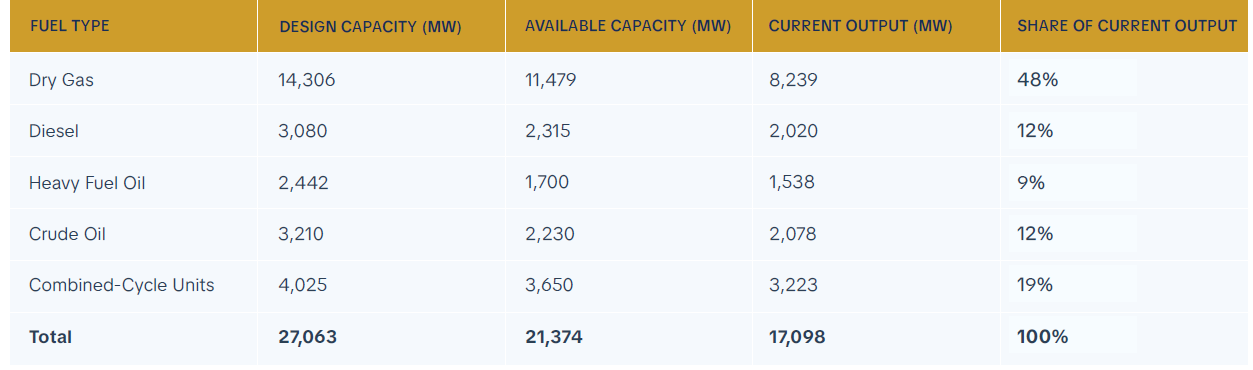
Operational availability remains constrained, with around 30% of the fleet reportedly out of service due to technical faults, maintenance requirements, or fuel shortages. As Table 1 demonstrates, the highest recorded output from these turbines has been limited to approximately 17 GW, equivalent to about 80% of available capacity, according to some estimates from technicians within the power sector.
Full operation of Iraq’s gas-fired and combined-cycle fleet on natural gas would require an estimated 130 - 137 million cubic meters per day, or around 47 – 50 billion cubic meters (bcm) annually. Current supply remains substantially below this requirement.
Available sector estimates indicate that domestic gas supplied to power plants amounts to approximately 31.5 million cubic meters per day. Of this number, imports from Iran averaged about 24 million cubic meters per day in 2025, which cost an estimated 2.8 billion USD per year. Only 7.5 million cubic meters are produced locally.
Collectively, these sources provide roughly 11.5 bcm annually, compared with an estimated requirement of 47 bcm. This implies a gas supply deficit of nearly 75% for gas-fired power generation and highlights the structural mismatch between Iraq’s installed generation capacity and the availability of suitable fuel.
Table 1: Iraq Power Generation Capacity and Current Output by Fuel Type, Q3 2025
Source: Compiled by the author based on official government statements, company disclosures, and publicly available industry reports.
The Costly Power Sector
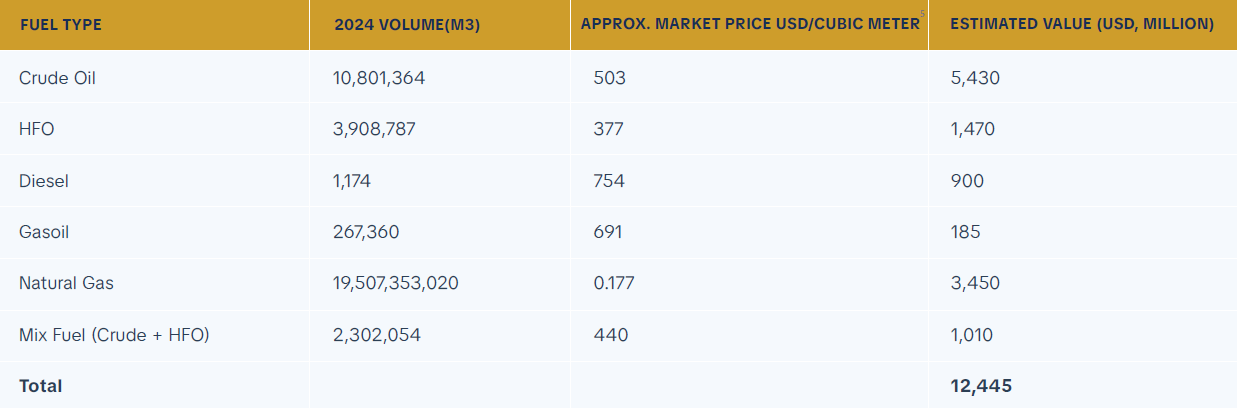
The annual budget of Iraq’s Ministry of Electricity for 2023–2025 amounted to approximately 15.5 trillion IQD,[3] comprising 11.6 trillion IQD in operational expenditures and 3.9 trillion IQD in investment expenditures and projects.[4] In 2024, the value of electricity sold to customers by the Iraqi government reached around 3 trillion IQD, while collections stood at approximately 2.3 trillion IQD, against accumulated arrears estimated at 9.9 trillion IQD. Consequently, the electricity sector recorded losses of around 13.2 trillion IQD in 2024. The losses, excluding fuel costs, are estimated at 16–18 trillion IQD at international market prices as Table 2 illustrates, as well as interest payments on loans from international organizations and investment banks.
Table 2: 2024 Fuel Consumption Volumes, Market Prices, and Estimated Value for Power Generation
Source[5]: Compiled by the author based on official government statements, company disclosures, and publicly available industry reports.
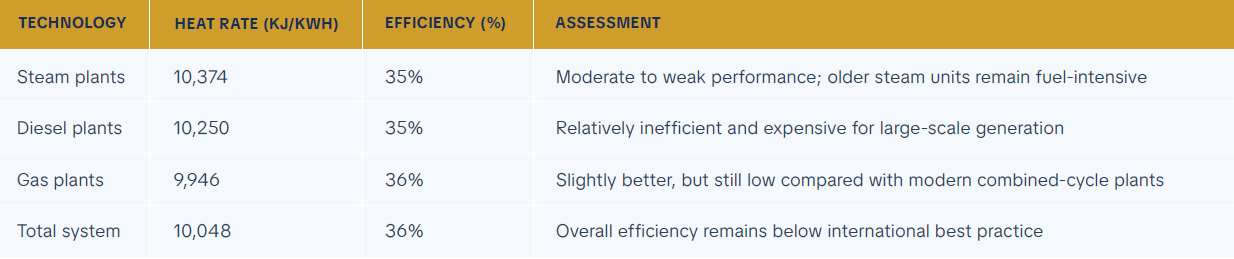
The sector’s high costs are compounded by low efficiency and capacity factors and high fuel consumption at ageing plants. In 2024, Iraq’s power-generation fleet had an overall heat rate of around 10,000 kJ/kWh, equivalent to an average thermal efficiency of about 36%. This reflects continued reliance on ageing units, open-cycle gas tur-bines, and diesel plants, as well as fuel-quality constraints and suboptimal operating conditions.
Accordingly, the sector’s principal challenge is not limited to adding generation capacity, particularly where new capacity would increase fuel demand. As Table 3 shows that the whole system’s efficiency is below international best practice. Greater priority should be given to improving system efficiency, reducing heat rates, and making better use of existing generation assets.
Table 3: Performance Assessment of Iraq’s Power Plants by Technology, 2024
Source: Compiled by the author based on official government statements, company disclosures, and publicly available industry reports.
Technical and Non-Technical Losses
Technical and non-technical losses in Iraq’s distribution networks remain a major structural challenge and should therefore be treated as a priority in any electricity-sector reform program.[6] The Kurdistan Regional Government has adopted this approach through its Runaki program, which combines distribution-network improvements, smart metering, improved revenue collection, and reduced reliance on private neighborhood generators. The program has so far enabled participating areas to receive more reliable, round-the-clock electricity.
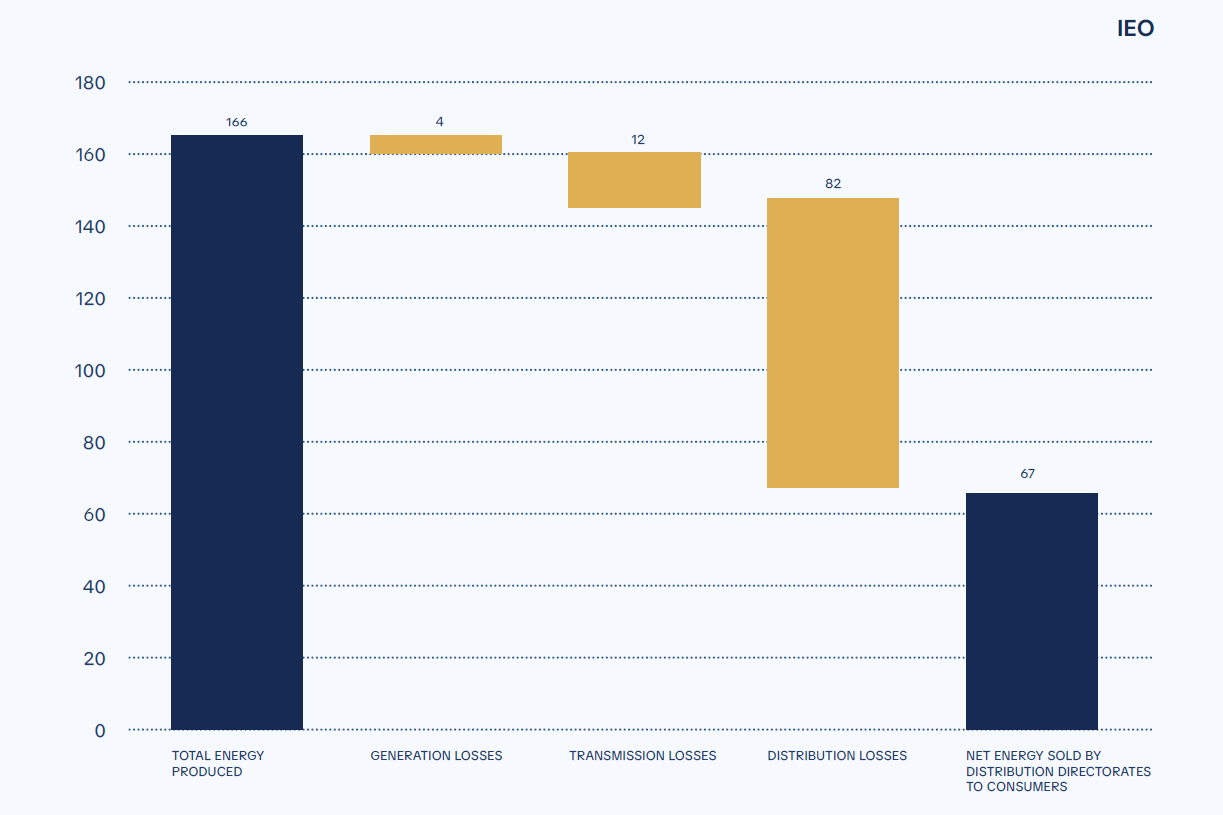
In 2024, total electricity produced amounted to approximately 166 terawatt-hours (TWh). After accounting for generation losses of around 4 TWh and transmission loss-es of about 12 TWh, electricity entering the distribution system was reduced to approximately 149 TWh. Of this amount, only around 67 TWh was sold by the distribution directorates to consumers, while approximately 82 TWh was lost at the distribution level.
The numbers in Figure 1 show that distribution loss-es alone accounted for nearly half of the total electricity produced and more than 55% of the electricity entering the distribution network. Consequently, addressing these losses is as important as adding new generation capacity.
Figure 1: Electricity Generation and Distribution Losses in Iraq, 2024
Source: Author’s calculations and assessment based on Ministry of Electricity data.
Rising Electricity Demand Will Intensify System Pressures
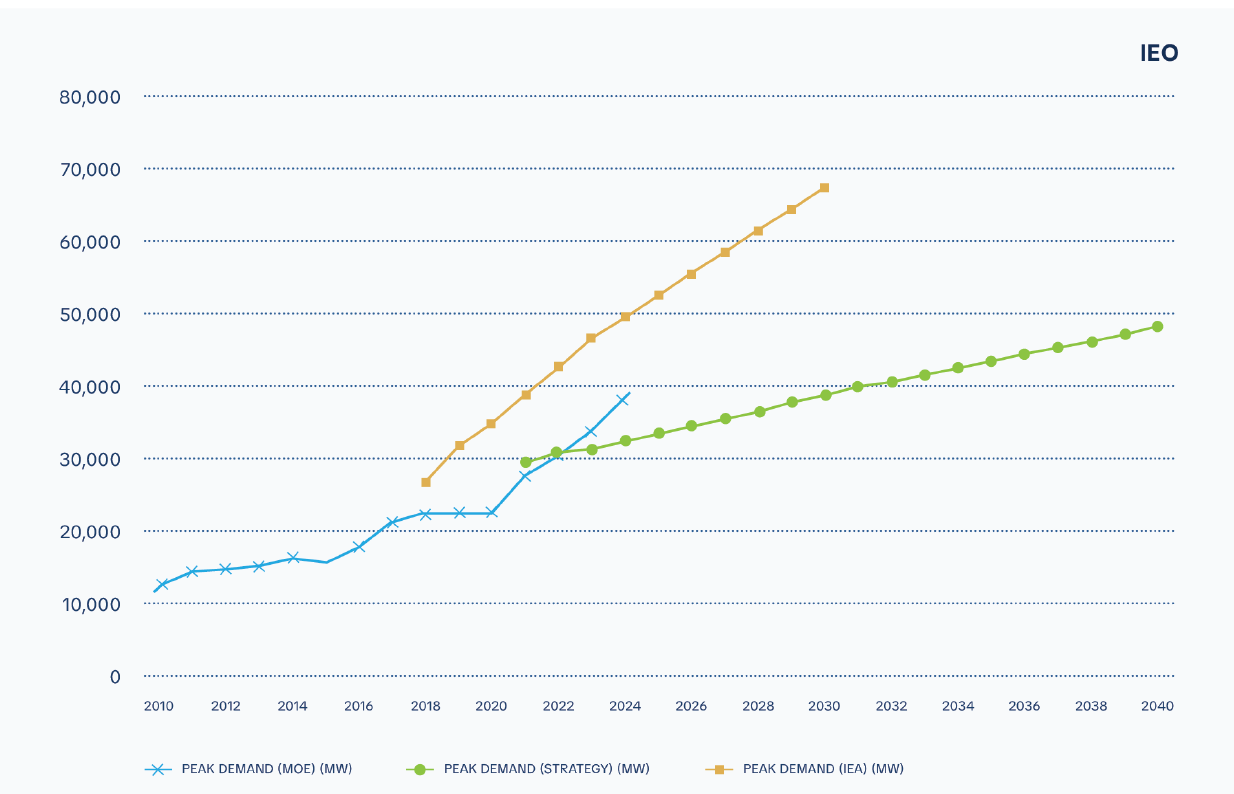
Long-term electricity demand in Iraq is expected to continue rising rapidly because of population growth, urbanization, and economic expansion.[7] According to the IEA, Iraq would require 68 GW of generation capacity by 2030, depending on economic growth and reform scenarios.[8] At the same time, reforms themselves could influence future demand growth. Better billing systems, tariff reform, demand side management, and reductions in electricity theft could improve efficiency and moderate future consumption growth.
Figure 2: Projected Peak Electricity Demand in Iraq, 2010–2040
Source: Author’s calculations and assessment
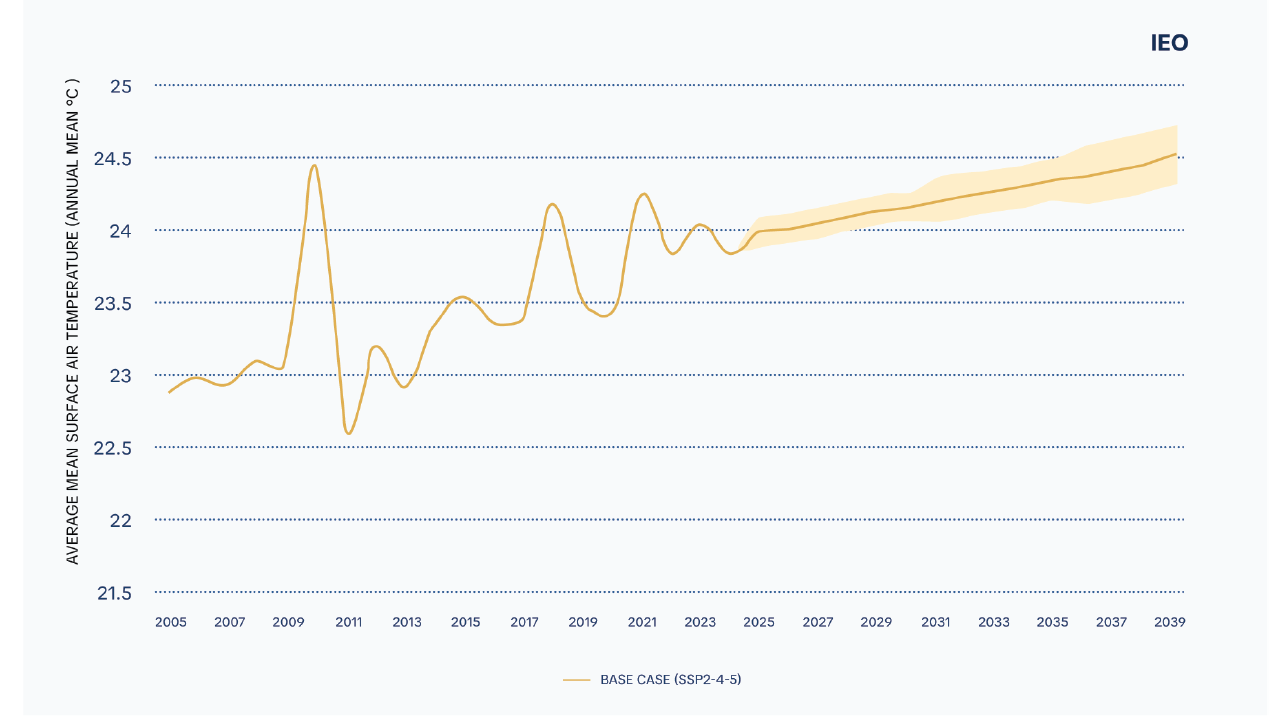
Additionally, climate change and the growth of cooling demand are expected to increase electricity demand, as Figure 3 demonstrates. Higher ambient temperatures directly increase the demand for cooling across residential, commercial, and public sectors, contributing to higher base-load consumption and more severe summer peak demand. Climate change is expected to become one of the principal drivers of prolonged heatwaves and increasingly extreme summer temperatures.[9]
Figure 3: Average mean surface air temperature based on the baseline scenario
Source: Author’s calculations and assessment.
Gas Dependence and Fuel Insecurity
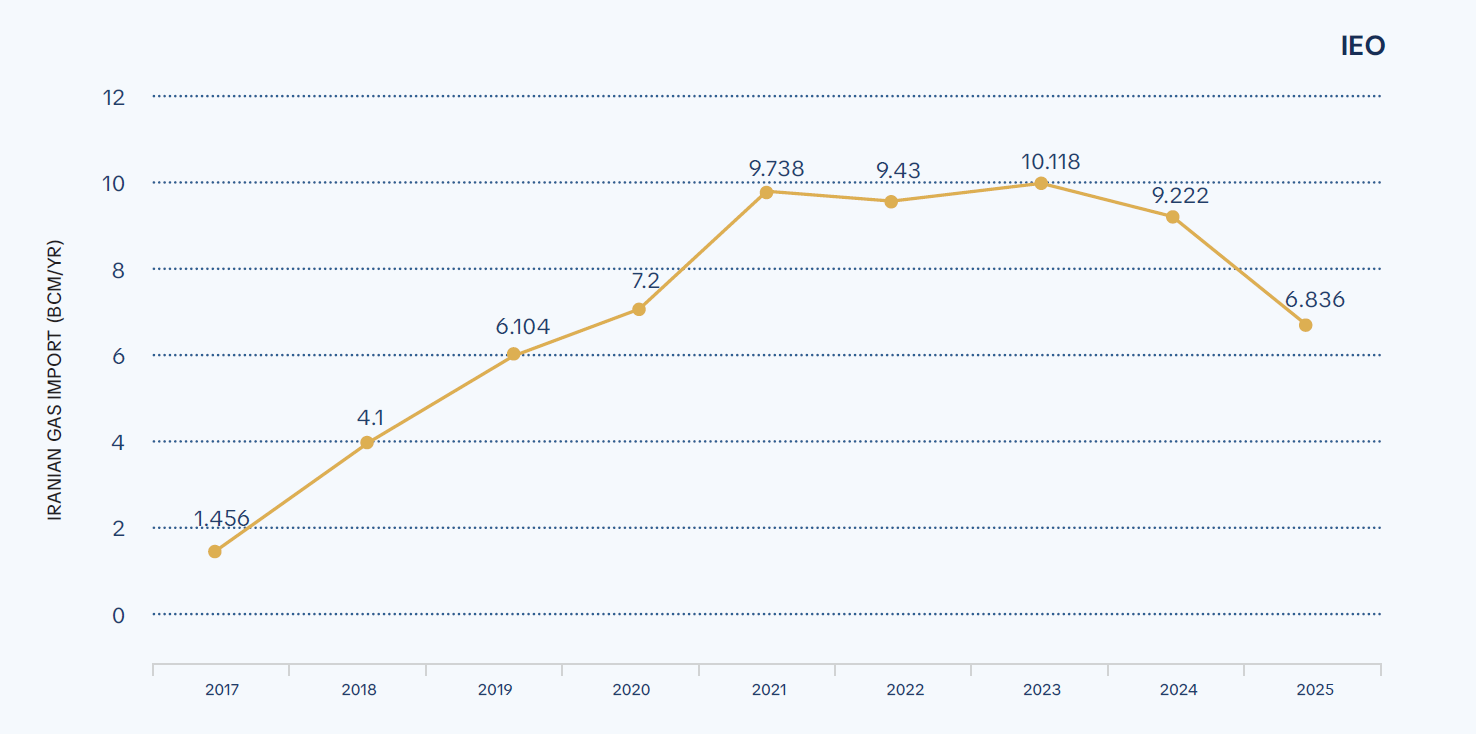
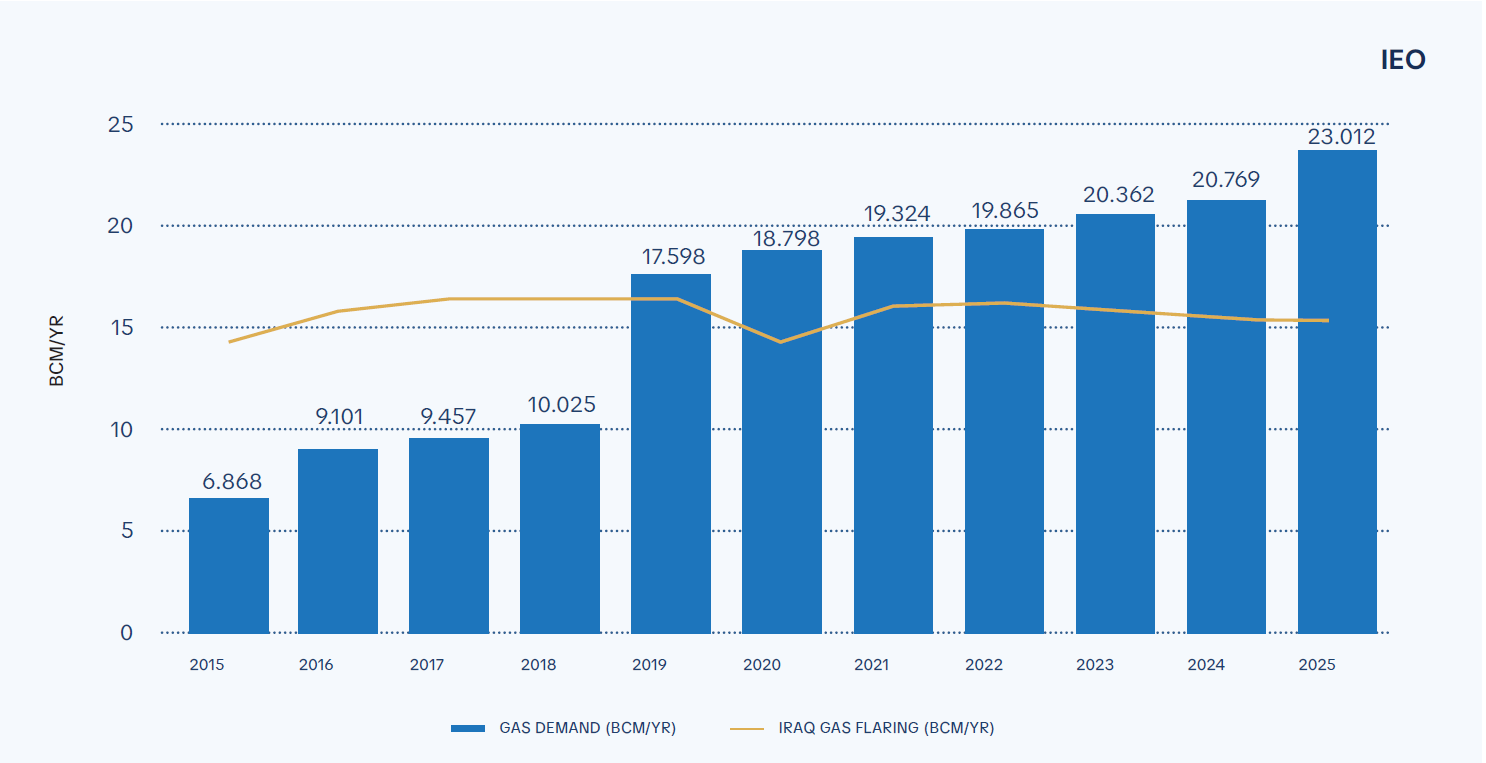
Demand for natural gas, mainly for power generation, increased from 6.8 bcm per year in 2015 to 23 bcm per year in 2025. Iranian gas remains a critical source for meeting this demand, accounting for more than 40% of the fuel used in Iraq’s power generation sector (Figure 4). However, the reliability of these supplies has recently deteriorated significantly. From a high of 10 bcm of imported Iranian gas in 2023, deliveries declined in 2025 due to a combination of rising domestic demand in Iran, recurrent supply interruptions, and payment restrictions linked to US sanctions on Iranian financial trans-actions.[10]
In March 2026, Iranian gas exports to Iraq were fully halted, leading to the loss of more than 3,000 MW of generation capacity. Although partial supplies resumed shortly thereafter, flows remained limited to around 5 million cubic meters per day, com-pared with previous levels of approximately 35 million cubic meters per day.[11]
By April 2026, the Ministry of Electricity reported that supplies to the southern governorates had been fully suspended, while deliveries to the central region remained sharply reduced. These disruptions required the Ministry to increase reliance on alternative fuels in order to keep selected gas-fired generation units in operation.[12]
Figure 4: Iranian Gas Exports to Iraq, 2017–2025
Source12: Author’s calculations and assessment.
It is unclear how post-war Iranian reconstruction will affect this gas supply. Historically, Iranian domes-tic market dynamics have always affected the supply of Iranian gas and electricity to Iraq.
Gas production is also expected to decrease inside Iraq if geopolitical risks remain elevated and if shipping through the Strait of Hormuz continues to be disrupted. In March 2026, restrictions on navigation through the waterway limited Iraq’s crude oil exports and placed significant pressure on storage capacity.[13] In response, Iraq declared force majeure on foreign-operated oilfields and curtailed oil production in the south, with available volumes redirected where possible to domestic refineries. Since a large share of Iraq’s gas is produced as associated gas from oilfields, the decline in crude output also reduced domestic gas availability.
In April 2026, the federal Ministry of Electricity reported that domestic gas production had fallen by more than 50%.[14] This created a dual im-pact: lower export revenues and reduced gas feedstock for processing facilities and power generation, further tightening fuel availability for the electricity sector.[15]
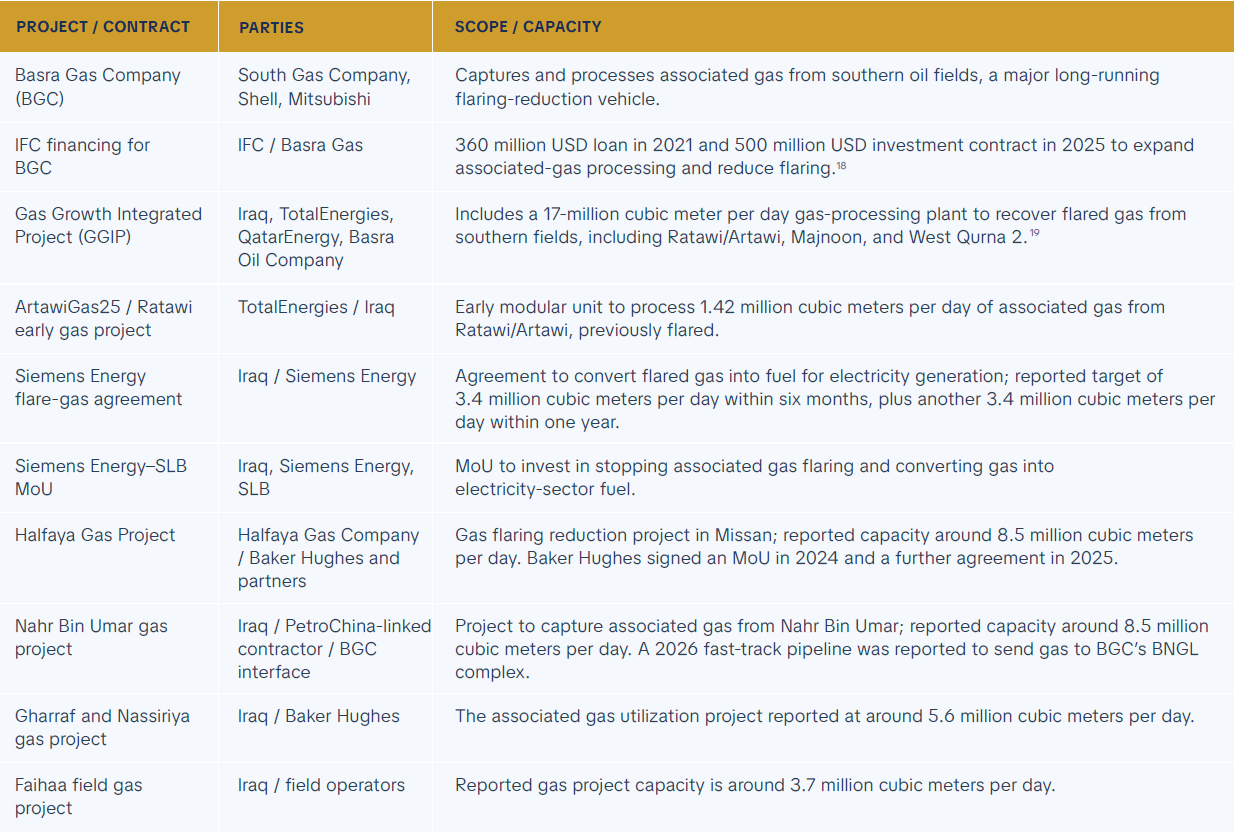
Iraq remains one of the world’s largest gas-flaring countries despite successive agreements and projects aimed at capturing and processing associated gas.[16] Several initiatives are underway to reduce flaring and increase domestic gas recovery, including by the Basra Gas Company, TotalEnergies’ Gas Growth Integrated Project, Baker Hughes-linked flare-gas recovery projects, and field-specific schemes at Halfaya, Nahr Bin Umar, Gharraf, Nassiriya, and Faihaa.[17] However, the target of eliminating gas flaring by 2028 ap-pears highly ambitious given the current scale and trajectory of flaring, as well as the infrastructure, financing, and implementation constraints facing the sector (Table 4).[18]
Table 4: Major Gas Recovery and Flaring-Reduction Projects in Iraq
Source[19]: Compiled by the author based on official government statements, company disclosures, and publicly available industry reports.
Following the completion of the KM250 expansion, the Khor Mor field has a reported gas-processing capacity of approximately 750 million standard cubic feet per day, equivalent to around 7.7 bcm annually.
If this entire volume were supplied to modern combined-cycle power plants, it could theoretically support approximately 4.5–5 GW of continuous generation, equivalent to around 40–44 TWh annually. Actual electricity output would be lower because of plant efficiency, availability, gas-processing constraints, trans-mission limitations, and interruptions to field operations. Khor Mor gas currently supports approximately 2–2.5 GW of power generation in the Kurdistan Region, but this figure reflects the existing generation system rather than the field’s theoretical gas-to-power potential.[20]
By 2030, Iraq’s domestic gas production is projected to increase to ap-proximately 24 bcm annually (Figure 5). However, even if all planned gas projects are delivered, domestic pro-duction would still meet only around half of the estimated fuel requirements of the electricity generation sector. This highlights the continued gap between Iraq’s growing gas-fired generation capacity and the avail-ability of domestic gas supply.
Figure 5: Iraq’s Natural Gas Demand and Gas Flaring Trends, 2015–2025
Source: Author’s calculations and assessment.
LNG Imports: Too Little, Too Late
There have also been delays to plans to increase imports of liquefied natural gas (LNG) using a leased floating storage and regasification unit (FSRU) at Khor Al-Zubair, which has further constrained the country’s ability to diversify fuel supplies ahead of 2026 peak summer demand. Originally announced in 2022 and later contracted to Excelerate Energy, the project was expected to import approximately 14 million cubic meters of gas per day, enough to generate 3,000–3,500 MW. [21]
However, implementation has now been postponed until 2027. Excelerate Energy confirmed that the Acadia FSRU, originally intended for Iraq, has been temporarily deployed to Jordan under a nine-month agreement with NEPCO at Aqaba.[22]
Additionally, the imported LNG is expected to be very expensive. The cost of Iranian gas is estimated at between 9.20 USD and 9.50 USD per million British thermal units (MMBtu), depending on Brent oil price and including pipeline transportation costs based on February 2026 prices. By comparison, the cost of the same unit of gas supplied through the LNG FSRU in Basra for the same month, on a hypothetical basis, could reach approximately 22 USD per MMBtu, or more than double the price of Iranian gas.
Delays to the GCCIA Electricity Interconnection
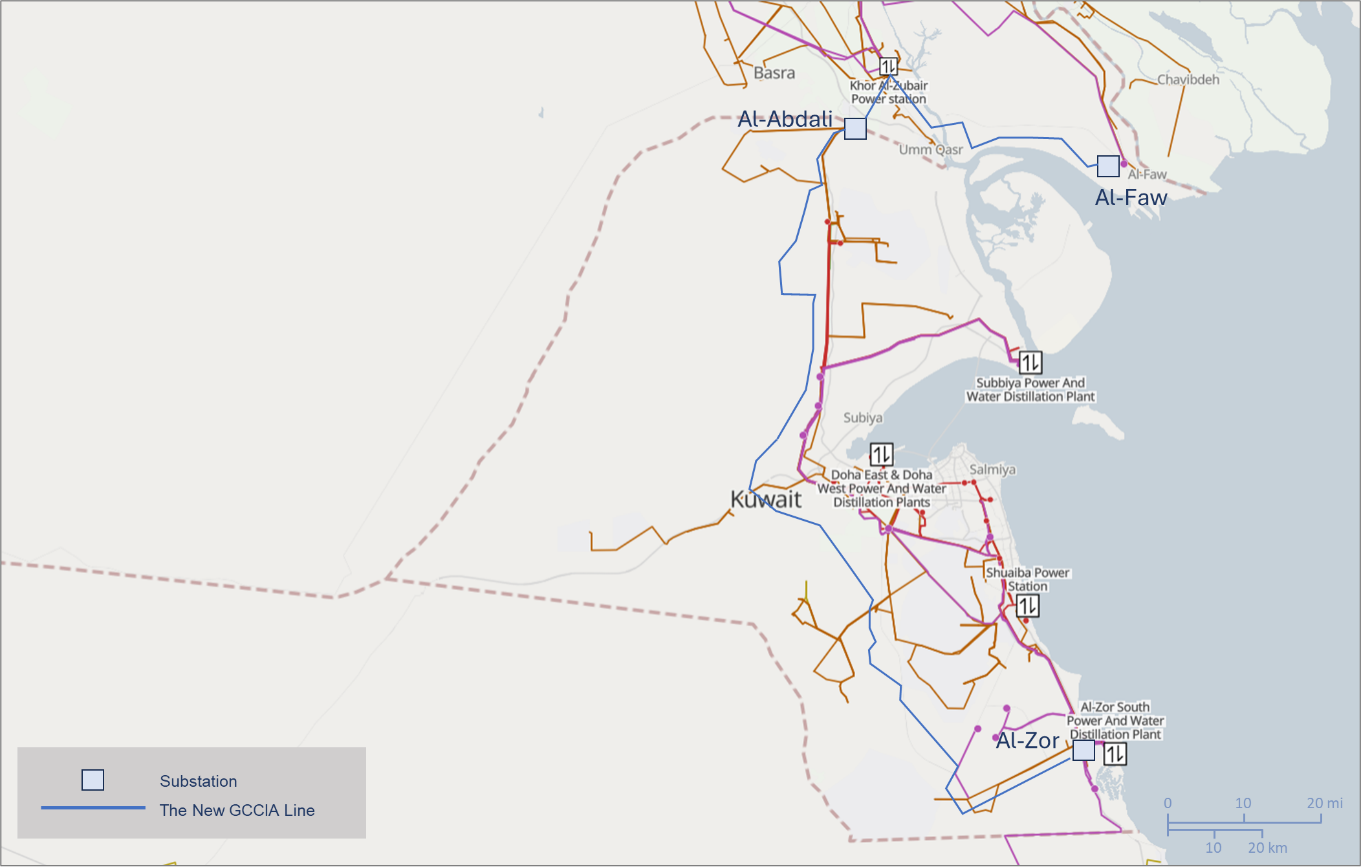
The Gulf Cooperation Council Interconnection Authority (GCCIA), which links up electrical grids across the region, has informed Iraq that the electricity interconnection through Kuwait was not commissioned as planned in early 2026. The first phase, expected to supply 500 MW, may now be delayed until late 2026 or possibly 2027.[23]
Although interconnection was not expected to resolve Iraq’s electricity crisis, it would have provided important support to the southern power network during the summer peak-demand period, particularly in Basra, where temperatures are expected to exceed 50°C.
The delay has been attributed mainly to regional political and security tensions, which impact implementation work in Iraq and Kuwait. Some reporting has also pointed to Iraq’s financial liquidity constraints, including the requirement to settle project-related costs before electricity supply begins.[24]
Figure 6: Al-Faw (Iraq) – Al-Abdali (Kuwait) GCC Interconnection
Source: Open Infrastructure Map.
Suspension of the Iraq–Türkiye Electricity Interconnection
The Iraq–Türkiye electricity interconnection, which began operating in July 2024 with an initial capacity of 300 MW, was expected to increase to 600 MW in a second phase. However, recent reporting indicates that the inter-connection has been suspended since September 2025, with an overdue debt reportedly the cause. However, no formal public announcement was issued by the Iraqi gov-ernment.[25] Unconfirmed reports suggest that Iraq pro-posed settling part of its outstanding debt for imported electricity from Türkiye through an oil-swap arrangement. In August 2025, the Turkish Karadeniz Power-ship Orhan Ali Khan arrived at Umm Qasr port in Basra under a short-term agreement with Kar Power-ship to supply emergency electricity to Iraq’s grid. Public reporting confirms that the broader power-ship contract covered up to 590 MW through two vessels, with Orhan Ali Khan later reported to have added around 300 MW to the grid.[26]
However, the reported costs associated with the agreement appear to be based on unconfirmed reporting or sector estimates rather than publicly disclosed contract documents. These include the tariff of approximately 0.15 USD/kWh, the estimated cost of about 1 million USD per day for roughly 315 MW, and the claim that the vessels consume around 1,400 tons of heavy fuel oil per day. These figures should therefore be presented as estimates, not confirmed contractual terms.
Hydropower Could Help
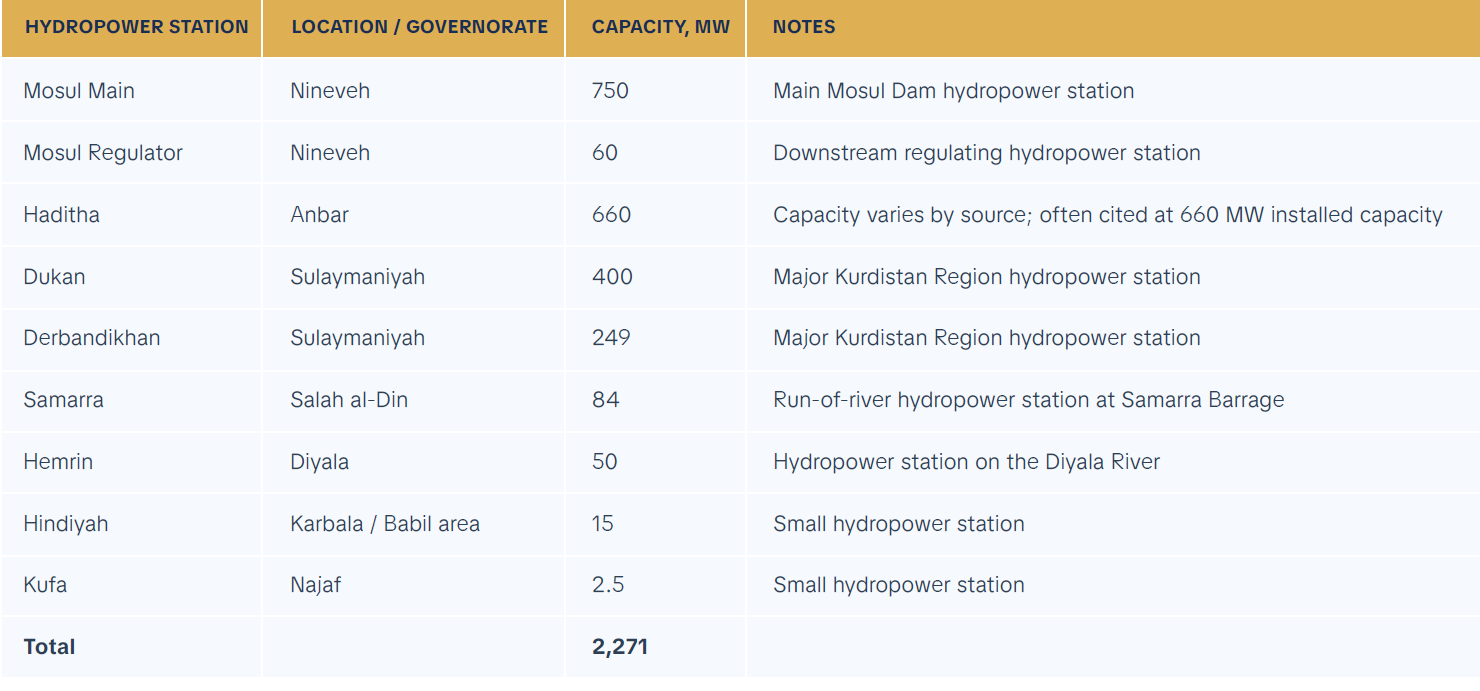
Hydropower could provide important seasonal support to Iraq’s electricity system, particularly during the peak-demand period. Following years of drought and reduced in-flows from Türkiye , improved water levels in the Tigris and Euphrates systems have increased the potential contribution of major hydropower stations. Iraq’s principal hydropower assets, including Mosul, Haditha, Dukan, Darbandikhan, and other smaller stations, have a combined installed capacity exceeding 2,200 MW. While this capacity cannot resolve the electricity deficit on its own, it could help reduce pressure on gas - and fuel-fired generation, provided that water releases are carefully coordinated with irrigation, drinking water, and broader water-security requirements.
Table 5: Hydropower Stations
Source: Compiled by the author based on official government statements, company disclosures, and publicly available industry reports.
Conclusions
Iraq’s electricity crisis is no longer simply a question of adding more generation capacity. It reflects deeper structural weaknesses in fuel security, system efficiency, network losses, investment planning, and institutional governance. Recent regional disruptions have exposed the risks of relying on imported gas and delayed infrastructure projects. Build-ing a resilient electricity sector will require not only expanding domestic gas production and generation capacity but also improving efficiency, reducing losses, diversifying fuel sources, and accelerating long-overdue market and governance reforms. Without such measures, Iraq’s electricity crisis will continue to re-emerge every summer.
Endnotes & References
1. Iraqi News, “Iraq Plans to Generate 30,000 Megawatts of Electricity in Summer,” April 23, 2026, https://www.iraqinews.com/iraq/iraq-plans-to-generate-30000-megawatts-of-electricity-in-summer.
2. Iraqi News Agency (INA) (October 2, وزﻳﺮ اﻟﻜﻬﺮﺑﺎء: ﺧﻄﺔ اﺳﱰاﺗﻴﺠﻴﺔ ﻟﺤﻞ ﻣﺸﻜﻠﺔ2025). اﻟﻄﺎﻗﺔ ﺑﺸﻜﻞ ﺟﺬري. Available at: Iraqi News Agency. https://ina.iq/ar/econo-mie/227726--.html
3. The annual operational and investment budgets of the Ministry of Electricity during 2023–2025 accounted for 7.8% of the total federal budget, excluding fuel costs.
4. The annual operational and investment budgets of the Ministry of Electricity during 2023–2025 accounted for 7.8% of the total federal budget, excluding fuel costs.
5. Using approximate 2024 international market prices for power-generation fuels.
6. Technical and non-technical losses mean illegal connections, weak metering, billing gaps, and low collection rates, and are broadly equivalent to the net electricity sold to consumers.
7. Iraq’s nominal GDP rose from about 50 billion USD in 2005 to approximately 280 billion USD in 2024, and could exceed 430 billion USD by 2040 under baseline growth assumptions.
8. International Energy Agency. (2026). Iraq: Electricity. IEA. https://www. iea.org/countries/iraq/electricity
9. Iraq’s annual mean surface air temperature increased from 22.16°C
in 1923 to 23.85°C in 2023. Based on projections under the SSP2-4.5 scenario, the average temperature is projected to reach 24.55°C by 2040, indicating a continued warming trend with implications for cooling loads.
10. Organization of the Petroleum Exporting Countries. OPEC Annual Statis-tical Bulletin 2026, 61st edition. Vienna: OPEC, 2026.
11. Kurdistan24. “Iranian Gas Exports to Southern Iraq Halted, Sparking Energy Supply Concerns.” 4 April 2026. Available at: Kurdistan24 (accessed 27 May 2026).
12. In March 2024, Iraq and Iran signed a five-year gas supply agreement
to extend Iranian gas exports to Iraq for use in power generation. Under the agreement, Iran is to supply Iraq with up to 50 million cubic meters of natural gas per day, depending on the requirements of Iraqi power stations, for a period extending to 2029. If mports fell from the contract-ed/required level of around 50 million cubic meters per day to 5 million cubic meters per day, the lost gas volume would be 45 million cubic meters per day, implying a generation loss of roughly 8–10 GW (Source: Reuters. “Iranian Gas to Iraq Resumes After South Pars Attack, Iraqi State News Agency Says.” 21 March 2026. Available at: Reuters).
13. Reuters. “Iraq Declares Force Majeure on Foreign-Operated Oilfields Over Hormuz Disruption.” 20 March 2026. Available at: Reuters (accessed 27 May 2026).
14. Kurdistan24. “Blackouts Loom for Iraq This Summer as Domestic Gas Collapses and Iranian Supply Falls Short.” 27 May 2026. Available at: https://www.kurdistan24.net/en/story/909898/blackouts-loom-for-iraq-this-summer-as-domestic-gas-collapses-and-iranian-supply-falls-short (accessed 27 May 2026).
15. Iraq used roughly 10–11 bcm/year of treated domestic gas for power generation before the Iran-war disruption, equivalent to about 28–31 million cubic meters per day. In energy terms, this could support approximately 5–6 GW of gas-fired generation continuously, depending on plant efficiency and availability.
16. The World Bank ranks Iraq among the leading global flaring countries, while the United States Energy Information Administration estimated that Iraq flared around 625 Bcf, or 17.7 bcm, of natural gas in 2023, making it the third-largest flaring country globally (Source: U.S. Energy Information Administration. Country Analysis Brief: Iraq. Washington, DC: U.S. Ener-gy Information Administration (EIA), last updated 14 July 2025).
17. Iraq Business News. “Iraq Expands Gas Projects to Curb Flaring.” 9
June 2025. Accessed 27 May 2026. https://www.iraq-businessnews. com/2025/06/09/iraq-expands-gas-projects-to-curb-flaring/
18. Reuters. “IFC Signs $500 Million Contract with Iraq’s Basrah Gas for Associated Gas, Development of Major Port.” Reuters, 13 September 2025.
19. Bernstein, A., Davis, M., Mitro, T., Perrine, T. (2025). Flaring Case Study: Iraq. New York: Columbia Center on Sustainable Investment (CCSI) and Capterio, June.
20. Currently, approximately 630 million standard cubic feet of gas per day
(MMscf/d) is produced and utilised at Khurmala, equivalent to about
6.5 bcm annually. In addition, around 50 MMscf/d is flared at Khurmala, while a further 18 MMscf/d is flared from other sources. Including the flared volumes, total gas production amounts to approximately 698 MMscf/d, or about 7.2 bcm annually. However, only around 6.5 bcm per year is currently available for productive use, while approximately 0.7 bcm is lost through flaring.
21. The vessel has a technical regasification capacity of approximately 30 million cubic meters per day, although Iraq’s contracted import volumes are lower.
22. GIIGNL (2026). Excelerate to deploy newbuild FSRU in Jordan. Available at: GIIGNL – Excelerate to deploy newbuild FSRU in Jordan
23. Salem, A. (2026, May 12). Iraq’s electrical interconnection with the Gulf States has been postponed. Iraqi News. https://www.iraqinews.com/iraq/iraqs-electrical-interconnection-with-gulf-states-postponed
24. Arabic21. “ان وتعرُّثُّ الربط الخليجي يشعلان صيف العراق ويفاقمان اﻟﻌﺠﺰ اﻟﻜﻬﺮﺑﺎئيريحرب إ” [“Iran War and Delays to the Gulf Interconnection Inflame Iraq’s Summer and Worsen the Electricity Deficit”]. 23 May 2026.
25. Reports indicate that Türkiye halted electricity exports to Iraq over unpaid dues, with one Al-Monitor report putting the outstanding bill at more than 70 million USD. However, the figure has not been publicly confirmed by Iraqi or Turkish authorities (Source: Al-Monitor. (2025, April). Türkiye stops electricity sales to Iraq after Baghdad fails to settle $70M+ bill, Al-Monitor. https://www.al-monitor.com/originals/2025/04/turkey-stops-electricity-sales-iraq-after-baghdad-fails-settle-70m-bill)
26. Reuters. (2025, August 21). Turkey’s Kar power ship to supply Iraq with up to 590 MW electricity. TradingView. https://www.tradingview.com/news/reuters.com%2C2025%3Anewsml_L8N3UC020%3A0-turkey-s-karpow-ership-to-supply-iraq-with-up-to-590-mw-electricity/