


The de facto closure of the Strait of Hormuz as a result of the Iran-Israel-US war ex-posed one of Iraq’s most enduring economic vulnerabilities: the over-whelming dependence of its public finances on uninterrupted oil exports. Within days of the start of the conflict, the disruption sharply reduced crude export volumes, depriving the federal government of Iraq of billions of dollars in expected revenues and delivering the most severe fiscal shock that Iraq has absorbed since 2003.
The immediate concern was straight-forward: could Baghdad continue financing the state? Oil revenues provide roughly 90% of federal government income and underpin virtu-ally every major public expenditure, including salaries and pensions, security, electricity subsidies, and the day-to-day operations of government institutions. A prolonged interruption of exports therefore threatens not only Iraq’s fiscal position, but also its political and social stability.
This article examines how the federal government has managed to cope with this unprecedented shock with-out experiencing immediate fiscal collapse. It analyzes the emergency mechanisms that have sustained government finances, assesses the country’s gradual fiscal recovery, and evaluates what conditions will be re-quired for Iraq to restore long-term fiscal stability.
Recovering, But Not Yet Recovered
Tensions in the Gulf have repeatedly escalated and then eased, only to re-escalate again. As a result, ship-ping through the Strait of Hormuz has remained caught between partial resumption and continued disruption. Iraqi oil exports recovered gradually in June, easing some of the fiscal pressures created by the crisis, but weakened again in July as increasing security risks undermined tanker traffic and buyer confidence.
The federal government continues to finance salaries, pensions, and other essential government functions through a combination of domestic borrowing, expenditure reprioritization, and the partial recovery of oil export revenues.[1] This should not be mistaken for a return to normal. Iraq currently receives only a fraction of the oil revenues that it did before the crisis and remains well below the fiscal position needed to finance its budget comfortably.
A meaningful recovery will require oil revenues to return to at least the levels recorded before February 2026. Despite recent improvements that mark remains some distance away. Full fiscal recovery, however, re-quires something considerably more demanding: restoring crude exports to around 3.5 million barrels per day while maintaining international oil prices above 84 USD per barrel.[2] The IMF estimates that only under those conditions can Baghdad comfortably meet its recurring obligations — salaries, pensions, and operational expenditures — without relying heavily on domestic borrowing or extraordinary fiscal measures. However, this fiscal recovery appears unlikely to occur by the end of 2026.
The Fiscal Shock: When Iraq’s Oil Revenues Collapsed
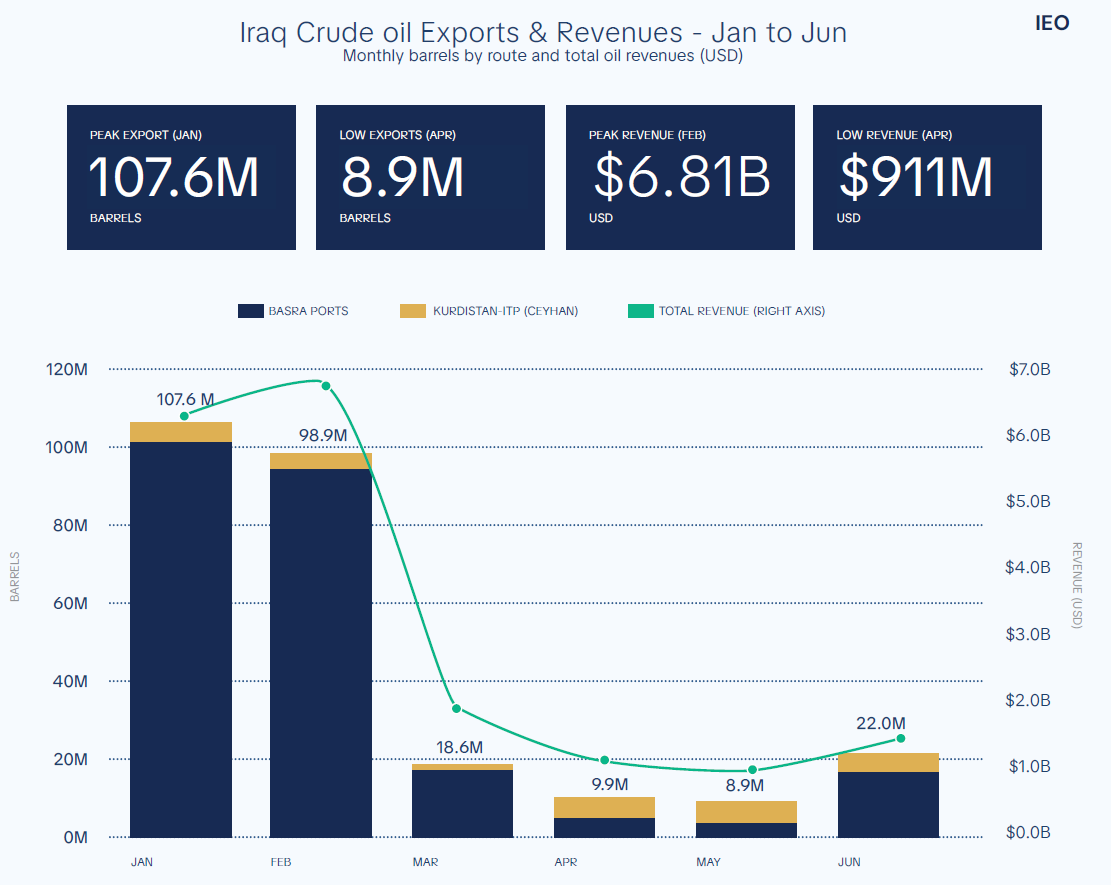
The de facto closure of the Strait of Hormuz transformed a regional security crisis into an unprecedented fiscal shock for Iraq. Within days, the country’s oil exports collapsed to levels not witnessed since the era of international sanctions during the 1990s, depriving Baghdad of its principal source of public revenue.[3] Because oil normally accounts for around 90% of federal government revenue, every barrel lost to export disruptions translated directly into reduced fiscal capacity. Figure 1 illustrates how the crisis evolved during the first half of 2026, showing its im-pact on Iraq’s oil exports, revenues, and public finances.
Iraq exported about 99 million barrels of crude during February 2026, which was equivalent to around 3.5 million barrels per day, through its southern Gulf terminals and the Iraq–Türkiye Pipeline. These ex-ports generated nearly 6.8 billion USD in monthly oil revenues. Within two months of the conflict beginning, exports had collapsed by more than 90%. By May, Iraq exported less than 9 million barrels of crude, or roughly 287,000 barrels per day, while monthly oil revenues had fallen to approximately 900 million USD — barely one-eighth of their pre-crisis level.
The collapse was driven primarily by the shutdown of Iraq’s southern export system. The Basra Gulf terminals, which normally handle almost 93% of Iraq’s crude exports, were effectively paralyzed by the disruption of commercial shipping through the Strait of Hormuz. Southern ex-ports fell from more than 101 million barrels in January to nearly 3 million barrels in May. This represent-ed one of the sharpest declines ever recorded in Iraq’s modern petroleum industry.
The northern export corridor through the Iraq-Türkiye Pipeline proved considerably more resilient. However, it operated well below its technical capacity because much of the production Kurdistan Region’s remained offline throughout the period due to security concerns about airstrikes.
Exports fluctuated through Ceyhan between roughly 4 million and 7 million barrels per month during the crisis, making it Iraq’s only relatively stable export outlet during the most difficult months of the disruption. Its limited capacity, however, meant it could compensate for only a small fraction of the losses from Basra. By June, the first signs of recovery began to emerge. As security conditions in the Gulf gradually improved and commercial confidence slowly returned, tanker movements through the Strait resumed.
Figure 1. Iraq’s Oil Exports and Oil Revenues During the Strait of Hormuz Crisis (January–June 2026)
Source: Compiled and estimated by the author using data from the State Organization for Marketing of Oil (SOMO) for January–April 2026; a formal SOMO letter submitted to the Iraqi Parliament for May–June 2026; June 2026 oil revenues and exported are based on Iraq Oil Report data and estimations.[4]
Southern exports recovered to ap-proximately 17 million barrels during the month, lifting Iraq’s estimated monthly oil revenues to around 1.4 billion USD. Al-though this represented a meaningful improvement over April and May, revenues remained far below the levels required to meet Iraq’s fiscal commitments without strain.
These figures also highlight an important distinction between revenue recovery and fiscal recovery. Revenue recovery means that oil exports have begun to rebound from the extraordinary lows that were recorded at the height of the crisis. Fiscal recovery, however, requires something far more demanding.
The federal government did not adopt a 2026 Budget Law and has in-stead managed public finances under the one-twelfth rule of the previous budget, authorizing monthly expenditures of up to one-twelfth of the 2025 budget appropriations. This spending level is subject to available revenues.
Based on the 2025 budget frame-work, the government requires ap-proximately 11.769 trillion IQD(around 8.98 billion USD)[5] each month to finance its current operating expenditures. By comparison, Iraq’s estimated oil revenues in June amounted to just 1.52 billion USD or about one-sixth of the amount needed to cover monthly operational spending.[6]
This gap explains why Baghdad has managed to avoid an immediate fiscal collapse while allowing underlying financial pressures to accumulate. The recovery of oil exports has eased the immediate fiscal shock, but it has not yet restored Iraq’s fiscal sustainability.
Baghdad’s Fiscal Strategy: Buying Time, Not Solving the Crisis
The federal government’s response to the oil-fiscal shock reveals a coherent, if risky, fiscal strategy. Rath-er than undertaking structural adjustment, Baghdad has chosen to preserve the state’s core functions on the working assumption that the current disruption to oil exports will end soon. Its policies over the past four months suggest a government pursuing fiscal endurance over fiscal reform. This strategy rests on three implicit assumptions.
First, that the crisis is temporary. The government’s continued reliance on domestic borrowing, treasury bills, and other short-term financing instruments signals that policymakers expect oil exports through the Strait of Hormuz to recover before Iraq’s financial buffers are exhausted.
Second, that political stability must take precedence over fiscal sustain-ability. In principle, when governments face severe revenue shortfalls, they reduce expenditures to restore fiscal balance. In Iraq, that option is politically constrained. Public-sector salaries, pensions, and social protection spending averaged approximately 7.2 trillion IQD (5.5 billion USD) per month in 2025.[7] These expenditures function as the country’s most important social safety net and underpin the political legitimacy of the state itself. Cutting them would almost certainly generate widespread social and political unrest.
Third, that time itself is a policy instrument. Every major measure ad-opted since the crisis began serves the same objective of buying time. Issuing treasury bills buys time by replacing lost oil revenues with domestic borrowing. Delaying infrastructure projects buys time by reducing immediate expenditure pressures. Using payment arrears buys time by postponing fiscal obligations. None of these measures generates new revenue or reduces Iraq’s dependence on oil.
Iraq’s strategy comes at a cost. As of the latest official data, the Central Bank of Iraq’s (CBI) foreign reserves have dropped to approximately 90 billion USD[8], equivalent to about 118 trillion IQD at the official exchange rate. While this remains a substantial financial buffer, continued reserve depletion would gradually con-strain the CBI’s ability to defend the exchange rate, finance imports, and support financial stability.[9]
This approach is not new. The federal government responded similarly during the oil price shock of 2014 and the COVID-19 collapse of 2020 by borrowing, delaying investment, and waiting for oil market conditions to improve. The critical difference today is that previous crises were driven by lower prices while exports continued uninterrupted. The cur-rent crisis stems from a disruption to export routes themselves.
Nevertheless, the strategy may yet prove successful — but only if its underlying assumptions hold. If shipping through the Strait of Hormuz continues to normalize and oil exports recover during the second half of the year, the government may gradually close its financing gap and avoid severe fiscal adjustments. While this strategy for preserving political and economic stability until oil revenues return may prove to be the most rational course of action avail-able under the circumstances, it also reveals the central weakness of Iraq’s political economy. [10]
Conclusion
The federal government has so far succeeded in preventing a fiscal crisis from becoming a state crisis. It has maintained the basic functions of the state despite an unprecedented collapse in oil revenues. Measures like domestic borrowing, expenditure reprioritization, deferred payments, and the gradual recovery of oil exports have bought valuable time, but not led to any sort of fiscal sustainability.
The country’s recovery remains largely contingent on the resumption of normal oil exports through the southern ports of Basra and the Strait of Hormuz. The crisis has demonstrated once again that Iraq’s deepest fiscal vulnerability is the state’s overwhelming dependence on a single export route and a single source of income. Unless that structural dependence is addressed, future geopolitical disruptions are likely to produce similar fiscal shocks, regardless of how effectively the current crisis is managed.
Endnotes & References
1. The New Region. “Central Bank of Iraq Denies Printing Money to Combat Financial Crisis.” 7 June 2026. https://thenewregion.com/posts/5572/cbi-denies-printing-money-to-combat-financial-crisis
2. IMF Country Report No. 25/183. “2025 ARTICLE IV CONSULTATION—PRESS RELEASE; STAFF REPORT; AND INFORMATIONAL ANNEX.” July 2025. https://www.imf.org/en/publications/cr/issues/2025/07/11/iraq-2025-article-iv-consultation-press-release-staff-report-and-informa-tional-annex-568569
3. Editorial Team, Iraq Energy Outlook. “Iraq’s Wartime Oil Revenue Crisis.” 14- 19. May 2026. Print.
4. Ministry of Finance of the Republic of Iraq. State Accounts through December 2025 for the Federal Budget ( ﻟﻠﻤﻮازﻧﺔ اﻻﺗﺤﺎدﻳﺔ2025ﺣﺴﺎب اﻟﺪوﻟﺔ ﻟﻐﺎﻳﺔ ﺷﻬﺮ ﻛﺎﻧﻮن اﻷول Baghdad: Ministry of Finance, 2026. https://www.mof.gov.iq/Budget-im-plementation-Archive.aspx
5. IQD–USD conversions are based on the official exchange rate of 1,310 IQD per 1 USD, which is used for budget preparation and execution. The parallel market exchange rate differs and has generally fluctuated above 1,510 IQD per 1 USD.
6. In 2025, the Iraqi Federal Government actually spent 141.23 trillion IQD (approximately 107.8 billion USD), equivalent to an average of 11.77 trillion IQD (9.0 billion USD) per month. During the same year, the government collected 124.19 trillion IQD (approximately 94.8 billion USD) in total revenues, averaging 10.35 trillion IQD (7.9 billion USD) per month. The figures indicate that, even before the Strait of Hormuz crisis in 2026, Iraq’s public finances were characterized by a sizeable gap between expenditures and revenues, highlighting the government’s heavy reliance on sustained oil exports and its limited fiscal flexibility in the face of external shocks.
7. Ministry of Finance of the Republic of Iraq. State Accounts through December 2025 for the Federal Budget ( ﻟﻠﻤﻮازﻧﺔ اﻻﺗﺤﺎدﻳﺔ2025ﺣﺴﺎب اﻟﺪوﻟﺔ ﻟﻐﺎﻳﺔ ﺷﻬﺮ ﻛﺎﻧﻮن اﻷول Baghdad: Ministry of Finance, 2026. https://www.mof.gov.iq/Budget-im-plementation-Archive.aspx
8. Amer Salem. “Central Bank of Iraq’s foreign reserves drop in Q2 2026.” June 18, 2026. https://www.iraqinews.com/iraq/central-bank-of-iraqs-foreign-reserves-drop-in-q2-2026/
9. There are several methods for assessing reserve adequacy. The IMF primarily uses prospective import coverage; for Iraq, reserves of approximately 50–55 billion USD would cover about five months of imports, implying a significantly weaker external buffer and reduced policy space for the Central Bank.
10. Hadley Gamble. “US companies will be ‘top priority’ in Iraq, new PM says.” June 25, 2026. https://www.thenationalnews.com/news/mena/2026/06/25/us-companies-will-be-top-priority-in-iraq-new-pm-says/