

Iraq's energy subsidy system is one of the largest and most durable in the Middle East. For decades — and with renewed urgency since the 2003 regime change — policymakers, economists, and international institutions have debated its cost, fairness, and intended impact. Despite all this activity, the debate has rarely produced reform.
Iraq’s federal government and the Kurdistan Regional Government (KRG) direct a substantial share of public resources toward subsidizing fuel products and electricity. The official rationale is familiar: keeping energy affordable protects household budgets and provides a tangible return to citizens from the country's oil wealth. These are legitimate reasons, but the system as it currently operates is neither efficient nor equitable.
Iraq's energy subsidies are overwhelmingly universal and flat. They apply regardless of income level, economic sector, or social need. A wealthy household consuming large amounts of fuel and electricity receives proportionally far more support than a low-income family with modest consumption. There is little to no targeting, limited transparency, and few mechanisms to redirect support toward those who need it most.
Why raise this issue now when Iraq's economy is under acute strain from regional conflict? The answer is precisely because of that challenge. The subsidy issue is not new, but familiarity should not be mistaken for irrelevance. When oil revenues fall by more than 80% in just one month, the government must face up to the rapid narrowing of its fiscal options, which are hampered in part by its large, untargeted subsidy bill.[1]
The subsidy system represents a more subtle expression of the same structural vulnerability that the ongoing regional conflict has laid bare: a chronic liability that intensifies fiscal pressure precisely when the state is least equipped to absorb it. To maintain the status quo, the government must borrow to procure electricity, gas, and premium-grade gasoline, only to sell them at artificially suppressed prices. The system will continue to erode national resources and create fertile ground for waste and corruption without reform that better targets beneficiaries, advances equity, and redirects support toward job-creating sectors, rather than indiscriminate consumption.
The following figures examine the scale and structure of Iraq's energy subsidies: what they cost the budget, what they cost the broader economy, and how Iraq compares with its regional peers.
The analysis draws on the IMF Fossil Fuel Subsidies Database,[2] which covers more than 160 countries and combines data on energy prices, consumption, taxation, and environmental costs. A key distinction runs throughout: “explicit subsidies” reflect direct fiscal costs, or money that government spends or forgoes to keep energy prices below their true supply cost; “implicit subsidies” capture broader economic and social costs that never appear in the budget, including environmental damage, health impacts, and the under-taxation of fossil fuels. Together, they reveal a burden that is considerably larger than official spending figures suggest.
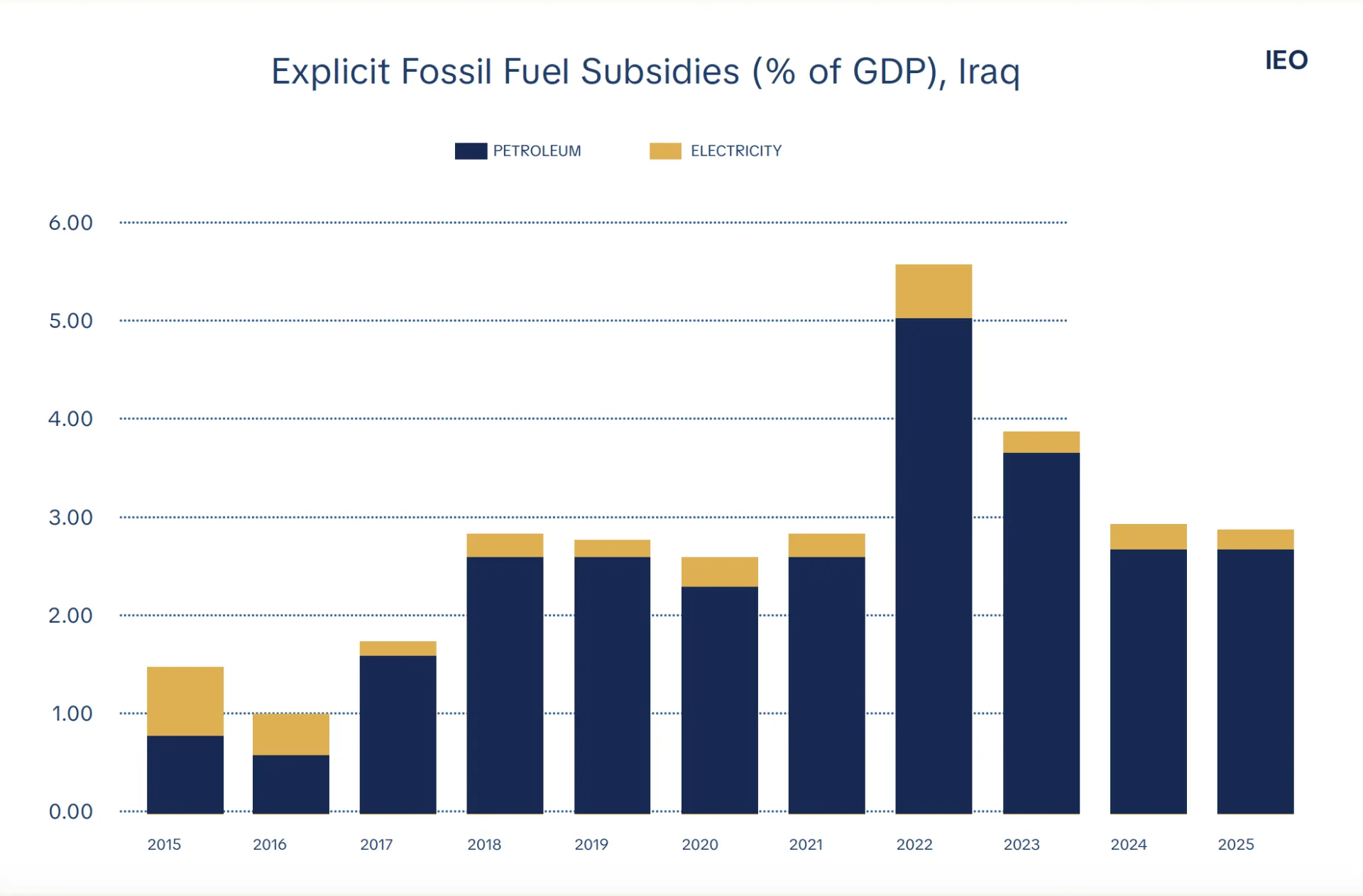
Figure 1. Explicit Fossil Fuel Subsidies in Iraq, 2015–2025 (% of GDP)[3]
Source: Figure adapted from International Monetary Fund, Fossil Fuel Subsidies, ArcGIS Online, accessed June 8, 2026, The data for 2024 and 2025 are mid-term projections, not finalized historical figures. https://climatedata.imf.org/datasets/d48cfd2124954fb0900cef95f2db2724_0/about
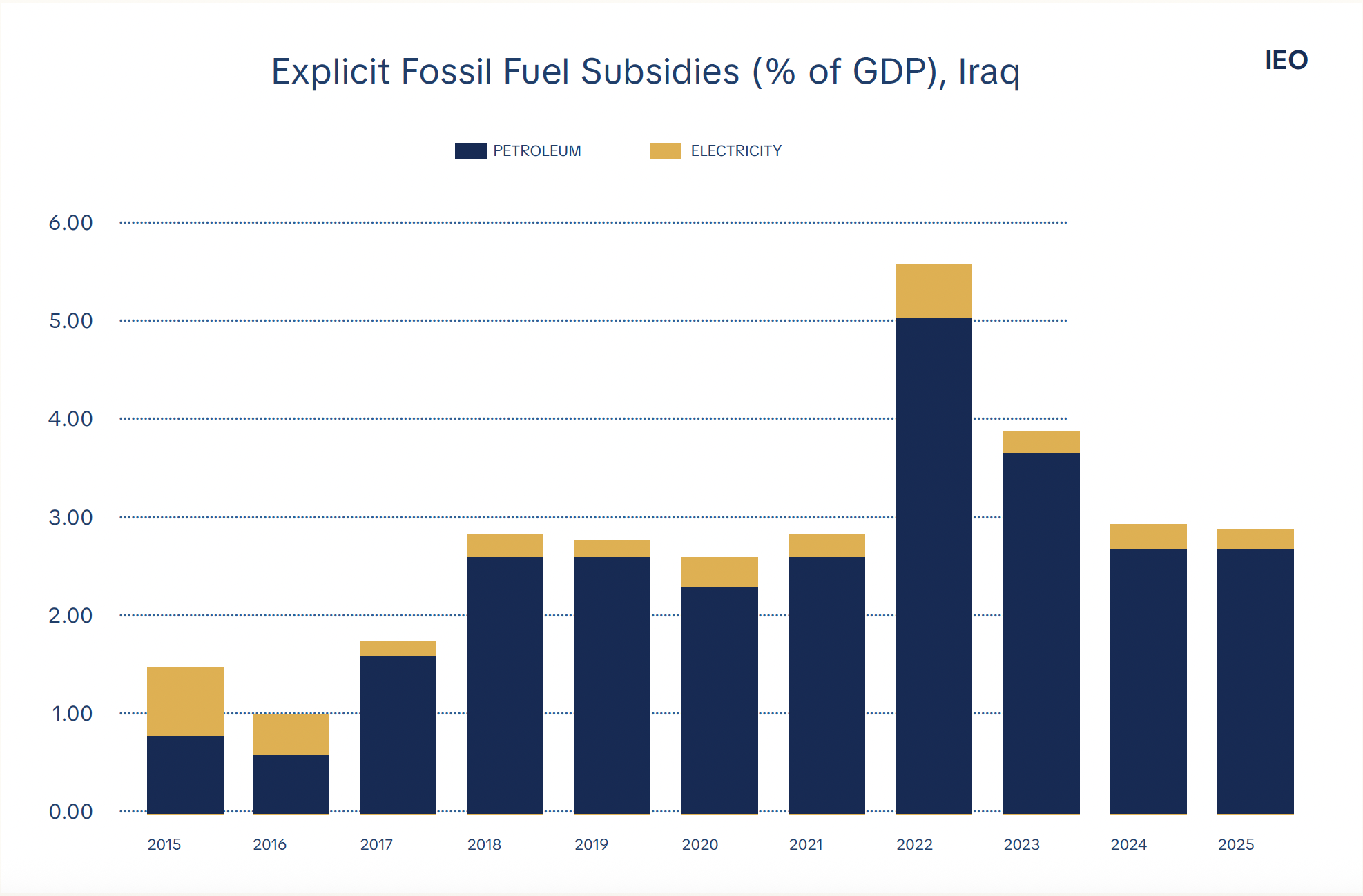
Iraq's explicit subsidy spending as a share of GDP has never been a marginal line item. Over the past decade, this ratio has fluctuated with oil price cycles, but rarely fallen to levels that could be described as a deviation. It represents an indicator of static priorities for a government facing chronic pressure on wages, infrastructure, and public services.
Between 2017 and 2022, explicit fossil fuel subsidies nearly tripled as a share of GDP, rising from roughly 1.5% to more than 5.5% — the sharpest spike in the series. Following the 2022 oil revenue peak, the ratio retreated and stabilized at around 2.9% of GDP between 2024 and 2025. The fact that subsidies held above pre-2018 levels even during a period of relative revenue abundance points to structural entrenchment rather than cyclical fluctuation: fiscal relief, when it came, did not translate into meaningful reform.
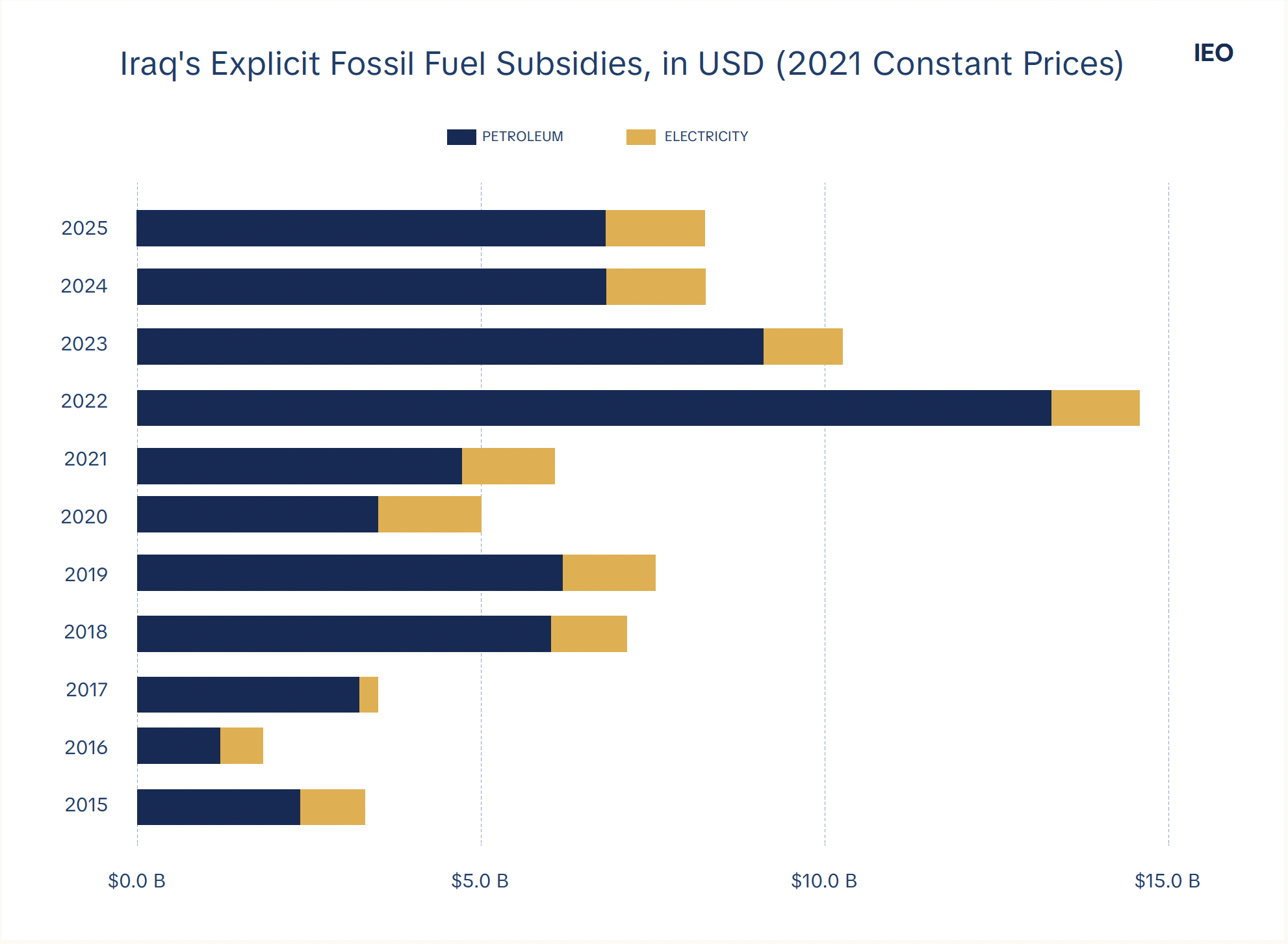
Figure 2. Explicit Fossil Fuel Subsidies, 2015–2025 (USD, constant 2021 prices)[4]
Source: IMF Fossil Fuel Subsidies Database; calculations and visualization by the Iraq Energy Outlook (IEO) editorial team. The data for 2024 and 2025 are mid-term projections, not finalized historical figures.
Expressed in real dollar terms, Iraq's explicit subsidy spending reveals a classic pro-cyclical pattern: outlays expand during periods of high oil revenues — notably in 2018–2019 and again in 2022–2024 — rather than holding steady or being reduced when the fiscal position improves. Instead of deploying windfalls to build savings or advance structural reform, the government allowed subsidy spending to scale with income, entrenching a system that becomes politically harder to unwind the longer it persists.
Explicit subsidies peaked at approximately 14.5 billion USD in 2022, falling back to around 8 billion USD by 2025, which is still nearly three times the 2016 level of 1.8 billion USD. Petroleum subsidies consistently account for the largest share of explicit subsidies, with electricity support playing a secondary but non-trivial role. That spending has failed to return to pre-2018 levels despite softer oil prices in 2023–2025 underscores how difficult it is to reverse politically sensitive price supports once they are established.
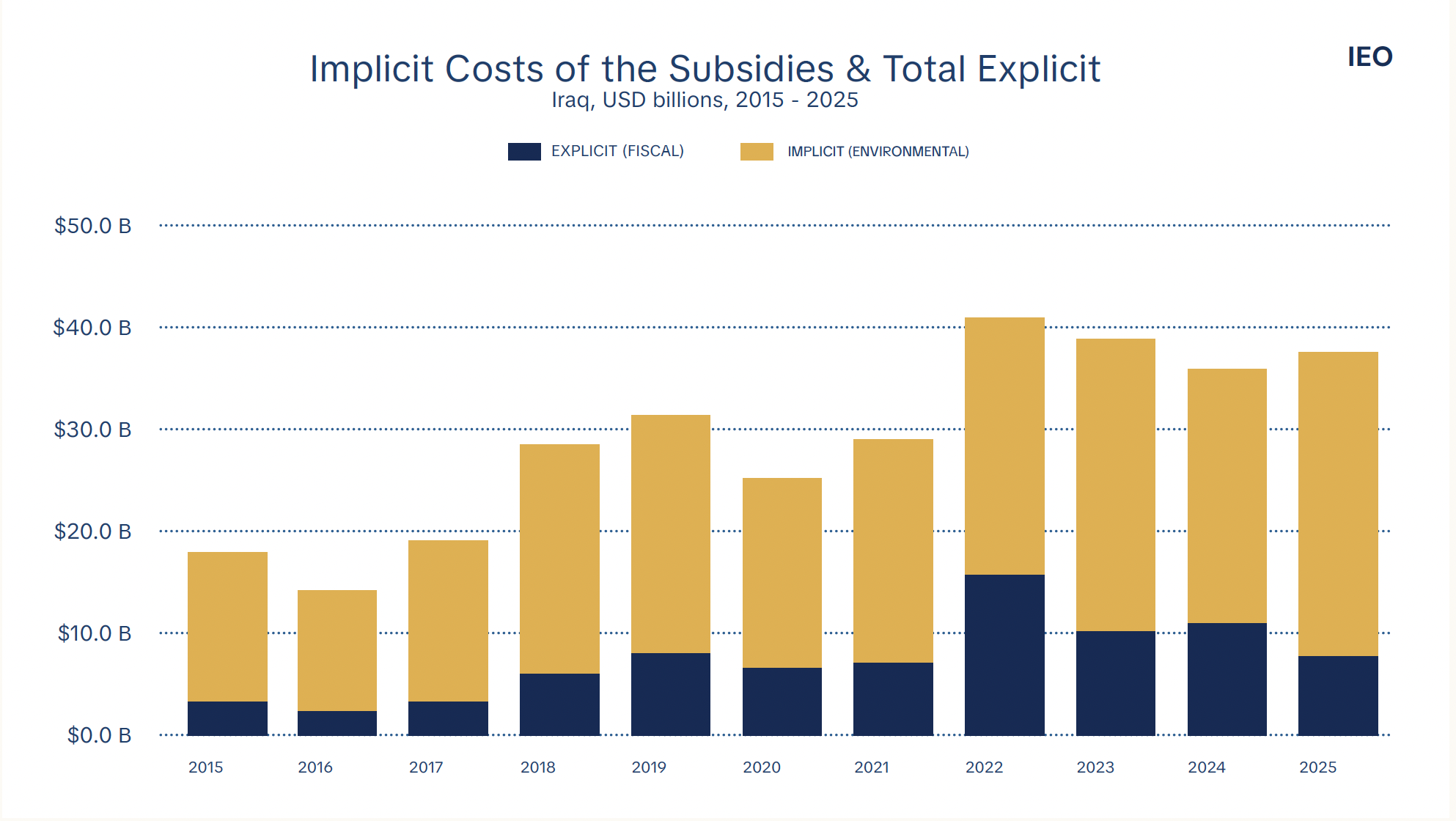
Figure 3. Total Fossil Fuel Subsidies, Explicit and Implicit Combined, 2015–2025 (USD, constant 2021 prices)
Source: IMF Fossil Fuel Subsidies Database; calculations and visualization by the Iraq Energy Outlook (IEO) editorial team. The data for 2024 and 2025 are mid-term projections, not finalized historical figures.
The budget numbers alone substantially understate the true cost of Iraq's energy pricing system. Adding the implicit subsidy burden — unpriced environmental and social costs — to explicit fiscal outlays reveals a combined figure that dwarfs what appears in government accounts.
As the Figure 3 demonstrates, implicit costs are consistently two to three times larger than explicit spending across the entire 2015–2025 period. Even in 2016, the lowest year for explicit subsidies, implicit costs remained above 11 billion USD. By 2025, they approached 30 billion USD on top of an explicit subsidy bill of around 8 billion USD. For policymakers, this is not an abstract accounting exercise.
These costs are real, falling on Iraqi society in the form of air pollution, public health burdens, infrastructure wear, and foregone investment in cleaner alternatives. Cheap energy, in this sense, carries a price — it simply falls elsewhere.
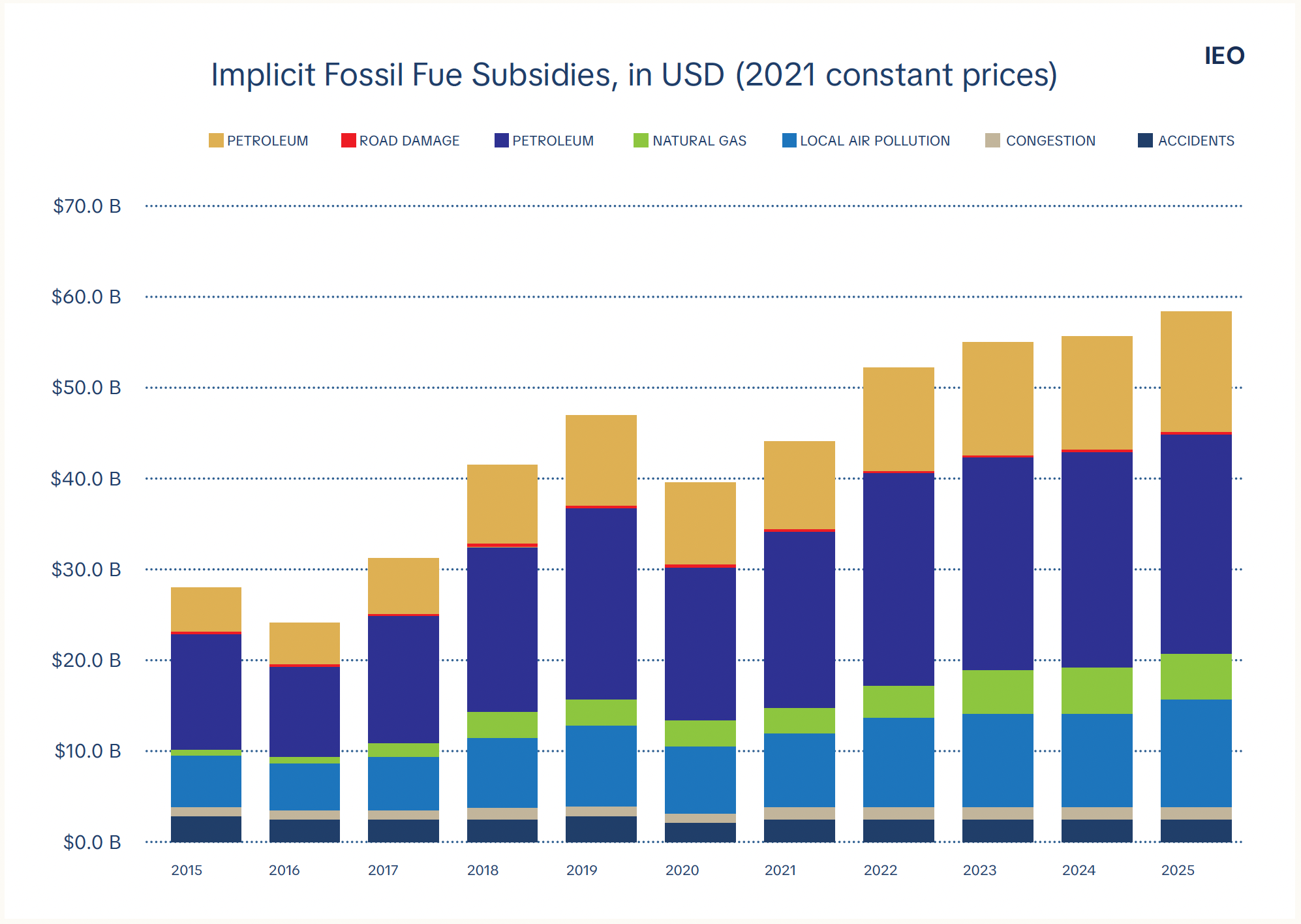
Figure 4. Implicit Fossil Fuel Subsidies by Category, 2015–2025 (USD, constant 2021 prices)
Source: IMF Fossil Fuel Subsidies Database; calculations and visualization by the Iraq Energy Outlook (IEO) editorial team. The data for 2024 and 2025 are mid-term projections, not finalized historical figures.
Not all implicit subsidy costs are the same. None of its main components — air pollution, global warming, road congestion, traffic accidents, road damage, and the effective under-taxation of fuel products — appear in energy prices, yet all are borne by Iraqi households, businesses, and public institutions. This matters for policy design, as different categories call for different responses to emissions regulation, fuel taxation, transport investment, and public health spending. Taken together, they show that the consequences of underpriced energy extend well beyond the Ministry of Finance.
Figure 4 shows that petroleum-related externalities and global warming costs account for the majority of Iraq's implicit subsidy burden, each contributing roughly 10 billion USD to 23 billion USD annually by 2025, with local air pollution the third-largest and fastest-growing category. This reflects rising vehicle use and power generation in Iraq. Road damage and congestion, while real, remain comparatively minor factors. The dominance of the first two categories means Iraq's implicit subsidy problem is fundamentally a carbon pricing gap: the country effectively charges nothing for the climate damage embedded in its fuel consumption.
Implicit subsidy figures are model-based estimates from the IMF's Fossil Fuel Subsidies database, not directly observed fiscal data[5]. They incorporate the IMF’s own social cost of carbon, local pollution damage, and congestion cost assumptions — all of which are subject to reasonable debate. For Iraq, the global warming and under-taxation components tend to dominate, producing aggregate figures that can appear very large relative to GDP.
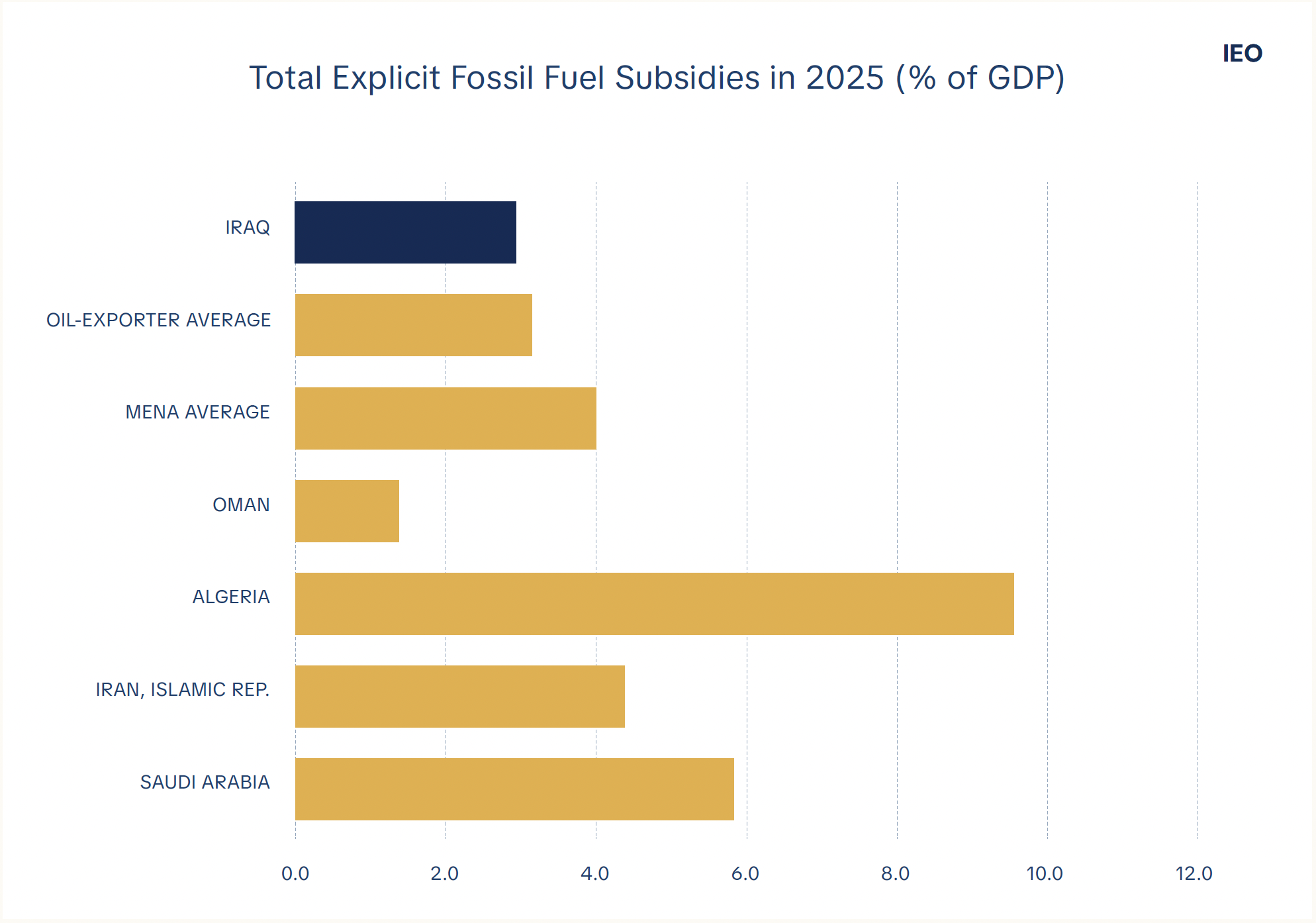
Figure 5. Explicit Fossil Fuel Subsidies as a Share of GDP, Iraq and Regional Peers
Source: IMF Fossil Fuel Subsidies Database; calculations and visualization by the Iraqi Energy Outlook (IEO) editorial team. The data for 2024 and 2025 are mid-term projections, not finalized historical figures.
Placed alongside its neighbors and regional peers of oil exporting states, Iraq's explicit subsidy burden sits in the middle of a crowded field. It exceeds Oman's, but is less than those of Iran, Algeria, and Saudi Arabia. At approximately 2.9% of GDP in 2025, it sits below both the MENA average of around 4% and the oil-exporter average of roughly 3.1%, and well below Algeria's outlier figure of 9.5%.
This relative position may appear reassuring, but it is a weak benchmark. Being near the average in a region that is defined by heavy subsidization offers little comfort. The more instructive reading is one of reform potential: several neighbors have undertaken subsidy rationalization programs that, with varying degrees of success, offer precedents for what works, what fails, and what political conditions are required to sustain change.