

The de facto closure of the Strait of Hormuz on March 4, 2026 exposed a fundamental structural vulnerability of Iraq’s economy. About 93% of the country’s crude oil exports normally transit via the Persian Gulf.[1] Following the reactive suspension of operations at Basra’s southern terminals, nationwide crude sales collapsed by more than 90%, from 3.567 million barrels per day (bpd) to an average of 329,000 bpd by May.[2] With seaborne exports offline, Iraq’s sovereign survival has become entirely dependent on the single — and politically compromised — northern pipeline corridor to Türkiye .
This report evaluates the technical, financial, and geopolitical implications of this export collapse. It analyzes the operational bottlenecks of the northern Iraq-Türkiye Pipeline (ITP) ahead of the July 2026 treaty-expiration and assesses west-ern and southern diversification alternatives, including the Basra–Haditha, Basra–Aqaba, Kirkuk–Baniyas, and Saudi Arabia (IPSA) pipelines. Finally, it evaluates the strategic options now available to Iraq following the continuous tensions over Strait of Hormuz (SoH) and proposes policy recommendations aimed at reducing the country’s long-term dependence on a single export corridor.
Since the completion of this report, the SoH has experienced renewed disruptions following a brief re-opening. These developments underscore the continuing fragility of Iraq’s oil export system and demonstrate that the temporary restoration of southern exports did not eliminate the country’s structural dependence on a single maritime corridor. The recurrence of the crisis highlights the urgency of diversifying Iraq’s export infrastructure and strengthening its long-term energy security.
The Anatomy of an Existential Chokepoint Crisis
The brent crude price spike in early March 2026, which carried prices past 120 USD per barrel, was the direct result of a structural supply shock in the Persian Gulf.[3] Following the outbreak of conflict involving the United States, Israel, and Iran in late February, Iranian maritime restrictions and kinetic operations effectively shut down the SoH, which serves as the transit pathway for 20% of global oil supply.[4] By late April, global energy markets faced a projected loss of up to 1 billion barrels of cumulative oil production.[5]
For Iraq, the maritime disruption represented one of the most severe export disruptions in the country’s modern history. The crisis demonstrated how quickly Iraq’s fiscal stability can unravel when access to the Persian Gulf is interrupted.
Unlike regional peers, Iraq never meaningfully diversified its export corridors; between 2021 and 2025, approximately 98.3% of Iraq’s exported oil quantity and value passed through the Persian Gulf.[6] When Iranian drone and missile strikes targeted commercial tankers loading at Iraq’s southern terminals on March 12, the federal government suspended southern port operations, halting the primary revenue stream on which the state depends for more than 90% of its annual budget.[7]
Figure 1: Map of Iraq’s oil export pipeline network and the wider region, prepared by the Dhia Jafar Center. Green lines mark pipelines currently operational; red lines mark pipelines that are dysfunctional or out of service; the dashed yellow line marks the proposed pipeline that has not yet been built.
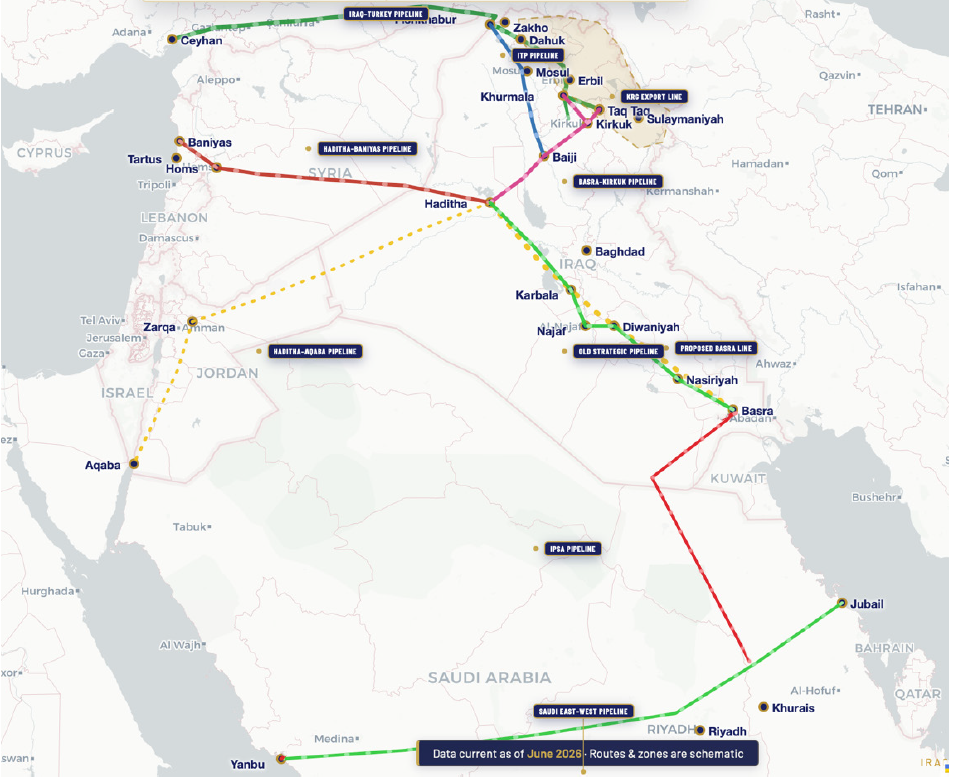
Source: Open Infrastructure Map.
As Iraqi energy experts have long observed, “Geography is sovereign.” Iraq’s extremely restricted access to open water makes its entire economic model structurally vulnerable to regional warfare.[8] The technical and fiscal feedback loops of this unilateral dependence materialized immediately:
1. CATASTROPHIC FISCAL COLLAPSE
Nationwide oil sales plummeted from a pre-crisis average of 3.567 million bpd in February to an average of 329,000 bpd in April and May. Gross oil revenues collapsed from 6.81 billion USD in February to approximately 1 billion USD per month in April and May.[9] Once international oil company (IOC) cost-recovery shares (17% to 25%) are deducted, net state receipts dwindle to 750–830 million USD. Against this stands a rigid wall of 5.45 billion USD in mandatory monthly cash transfers (including 3.88 billion USD for public salaries and 1.22 billion USD for pensions), with total operational expenditures reaching 7.2 billion USD.[10]
2. MONETARY FINANCING AND SOVEREIGN DISTRESS
To bridge its compounding fiscal crisis, the state has borrowed 8 billion USD domestically during the first four months of 2026, rapidly drawing down its foreign exchange reserves to approximately 97 billion USD at the end of April 2026 to cover a cumulative three-month operational shortfall approaching 17.5 billion USD.[11] While Foreign Minister Fuad Hussein stated that the state expanded its financial capacity by injecting 25 trillion IQD (~19 billion USD) to sustain public salaries past July 2026, the Central Bank of Iraq (CBI) clarified that this was achieved through issuing treasury bills rather than unbacked currency printing. However, using commercial banks as intermediaries to monetize government debt has significantly depleted reserves. Consequently, S&P placed Iraq’s credit rating on CreditWatch negative, while the IMF expects the national economy to contract by 6.8% in 2026. [12]
3. UPSTREAM RESERVOIR HAZARDS
Lacking sufficient domestic storage capacity, onshore tank farms in Basra be-came saturated within days of the prolonged shipping disruption, forcing operators to implement emergency wellhead shut-ins.[13] Extended production shut-ins in major southern fields, including Rumaila, West Qurna-1, West Qurna-2, Zubair, Halfaya, and Maysan, may create reservoir management challenges that vary according to geological and operational conditions. In reservoirs with active aquifer support, prolonged shut-ins may increase the risk of water encroachment, potentially reducing production efficiency and ultimate recovery.[14] Extended inactivity may also increase the risk of corrosion associated with formation brines and hydrogen sulfide in susceptible wells, complicating restart operations and potentially requiring costly workover interventions.[15]
The Northern Corridor: Sovereignty, Treaties, and the July 2026 Deadline
The SoH crisis transformed the northern export corridor via the Iraq-Türkiye Pipeline (ITP) into Baghdad’s principal alternative ex-port route, despite its limited capacity and constraints.[16] However, utilizing this route requires navigating a complex set of legal, financial, and sovereignty disputes. Access to the ITP has long functioned as a primary flashpoint between the federal government of Iraq (FGI) and the semi-autonomous Kurdistan Regional Government (KRG).
For the KRG, hydrocarbons historically functioned as a primary instrument of political and fiscal leverage, but ongoing legal and security crises have severely constrained its autonomy, transforming the KRG’s energy sector into a site of permanent stress.[17] Following the launch of the KRG’s independent crude sales in 2013, Baghdad initiated arbitration at the International Chamber of Commerce (ICC) in Paris.[18] In March 2023, the ICC ruled in Baghdad’s favor, ordering Türkiye to pay 1.47 USD billion in damages for facilitating unauthorized Kurdish crude exports between 2014 and 2018, prompting Ankara to suspend all pipeline flows.[19]
A US-brokered interim agreement in September 2025 enabled the resumption of crude exports from the Kurdistan Region under the authority of federal oil marketer SOMO, with initial export volumes ranging between 180,000 and 230,000 bpd.[20] The subsequent Iran–US–Israel conflict disrupted these exports as IOCs suspended operations following regional bombardments. After the immediate security disruption eased, a renewed political dispute emerged in early March 2026 when the KRG declined to facilitate the export of Kirkuk crude through the Kurdistan pipeline, citing disagreements over customs-duty revenues, the implementation of the Automated System for Customs Data (ASYCUDA), and broader fiscal disputes that included Kurdish access to US dollar liquidity through the CBI.
Under renewed US diplomatic pressure, Baghdad and the KRG reached a temporary agreement on March 17, allowing approximately 170,000–183,000 bpd of Kirkuk crude to resume flowing through Kurdish-controlled export infrastructure.[21] The recovery gathered further momentum in early June 2026, when international oil companies (IOCs) operating in the Kurdistan Region gradually restarted production, adding nearly 150,000 bpd to northern export volumes.
The legal framework governing the ITP — which was first signed in 1973 and amended in 2010 — is set to expire on July 27, 2026. Türkiye has formally notified Iraq that it will not renew the agreement under current terms, citing Iraq’s failure to deliver the treaty-mandated minimum of 1.5 million bpd.[22]
Türkiye is currently demanding transit fees far higher than the current baseline tariff of 1.25 USD per barrel, idle-capacity maintenance fees paid to Turkish state pipeline operator BOTAŞ, and the settlement of Türkiye ’s outstanding debt from the 2023 ICC arbitration ruling[23]. Furthermore, Turkish operators were revealed to have reappropriated one of the ITP’s two parallel lines (which consist of a 46-inch and a 40-inch diameter line with a combined nameplate capacity of 1.6 million bpd) to transport domestic crude produced from Türkiye’s Gabar mountains to Ceyhan with-out seeking Iraqi consent.[24]
To avoid a complete halt of northern exports, the Iraqi Council of Ministers amended Resolution 254 on May 27, 2026, extending the pipeline contract negotiation period for four months.[25] Baghdad is simultaneously accelerating the rehabilitation of the Kirkuk-to-Fishkhabour line, the main extension of the pipeline in-side Iraq. This federally controlled segment runs from Kirkuk through Salahaddin and Nineveh provinces, bypassing the KRG network entirely. However, it has been inoperable since 2014 following years of conflict, extensive sabotage, oil theft, and infrastructure degradation. It will require substantial rehabilitation be-fore operations can fully resume.[26]
The pipeline’s immediate export potential is constrained not only by infrastructure challenges and negotiations with Türkiye , but also by Iraq’s current production profile. Existing output from Kirkuk and the Kurdistan Region is largely committed to domestic refinery demand, leaving only a limited volume available for export. Consequently, Baghdad and Ankara are also exploring a broader strategic arrangement, including the possible construction of a pipeline linking Basra to Kirkuk, which would enable southern crude to access the Türkiye export corridor and substantially expand the long-term commercial viability of the ITP.
In a critical effort to ensure continuity following the expiration of the previous treaty on July 27, Türkiye’s state-owned pipeline operator BOTAŞ, Iraq’s State Organization for Marketing of Oil (SOMO), and the North Oil Company signed a one-year transit agreement on August 1. The agreement provides for a stated daily capacity or minimum contracted volume of 750,000 barrels per day (bpd). However, actual flows remained at approximately 170,000 bpd when the agreement was reported; therefore, 750,000 bpd should be understood as the agreement’s stated volume, not the current flow.[27]
Western Pipeline Alternatives: Redux and Geopolitical Friction
In a bid to establish long-term strategic autonomy, Iraqi planners have also accelerated several overland pipeline proposals designed to route southern crude westward. These projects face distinct technical challenges and geopolitical obstacles, but are critical to any diversification of export routes.
1. THE BASRA–HADITHA PIPELINE: THE STRATEGIC BACK-BONE
The 4.6 billion USD to 5 billion USD Basra–Haditha pipeline represents Iraq’s most viable midstream project.[28] This 56-inch diameter, 685-to-700-kilometer system is designed to transport up to 2.25 million to 2.5 million bpd of southern crude from Basra to the K-3 pumping station in Haditha, located in western Iraq’s Anbar governorate.[29] The strategic importance of the pipeline lies in its versatility. Once completed, it can supply central and northern refineries, connect to northern Ceyhan routes, or act as the trunkline for proposed over-land pipelines to Jordan and Syria.
The project officially entered the construction phase on May 1, 2026.[30] The government approved an initial allocation of 1.5 billion USD for 2026, financed through the bilateral Iraq-China Framework Agreement’s “oil-for-infrastructure” mechanism.[31] The project is being executed by the state-owned Basra Oil Company (BOC) and the State Company for Oil Projects (SCOP), drawing on equipment agreements signed with the State Company for Iron and Steel in January 2025.[32] Despite this early momentum, no significant construction progress had been reported by late July 2026.
On July 4, 2026, the cabinet approved preliminary agreements to evaluate key strategic oil export corridors, including the Basra–Haditha–Kirkuk–Ceyhan and Basra–Haditha–Baniyas routes. It authorized the BOC to work with an international consortium on technical and financial feasibility studies and to engage the US engineering firm KBR as a consultant for the Basra–Haditha pipeline project. Although these agreements create no binding financial or contractual obligations, they signal Baghdad’s cautious but proactive commitment to diversifying Iraq’s oil export infrastructure.[33]
2. THE BASRA–AQABA CORRIDOR (JORDAN)
First devised in 1983 during the Iran-Iraq War to by-pass Persian Gulf maritime chokepoints, the project was championed by the Reagan administration and the Bechtel Corporation, with the US Ex-Im Bank offering 500 million USD in financial guarantees. Negotiations stalled over Iraqi fears of an Israeli attack on Jordan’s Aqaba terminal.[34] Despite intensive backdoor diplomacy — involving Swiss financier Bruce Rappaport and Israeli Prime Minister Shimon Peres, who offered a written non-aggression pledge in exchange for secret Labor Party funding — Iraq rejected the Bechtel proposal in late 1985, citing inflated costs.[35]
The project was revived in April 2013 as an oil corridor over 1,680 kilometers, but was halted in 2014 when the Islamic State captured Anbar governorate.[36] It was recently estimated that a revived Basra–Aqaba project would cost approximately 10.55 billion USD at 2025 prices.[37] However, expert Ahmed Mousa Jiyad warns that the project continues to suffer from shifting cost estimates and a critical lack of transparency.[38]
Today, the pipeline remains in the pre-construction phase and faces severe domestic political opposition, with critics arguing that the pipeline would bring Iraqi crude into close physical proximity with Israel. Further-more, because the Red Sea remains exposed to Houthi drone strikes, the route merely exchanges one choke-point risk for another.
3. THE KIRKUK–BANIYAS CORRIDOR (SYRIA)
Built in 1952 by Bechtel for the Iraq Petroleum Company (IPC) with a capacity of 300,000 bpd, the history of this pipeline to Syria is defined by political conflicts.[39] Following the nationalization of the IPC in June 1972, Syria seized the pipeline segment in its territory and demanded a doubling of transit fees, prompting Baghdad to build the “Strategic Pipeline” in 1975 to route Kirkuk crude south to the Gulf.
Iraq stopped pumping via Syria in 1976.[40] Although flows resumed briefly in 1979, the Syrian regime shut down the pipe-line in April 1982 in concert with Tehran during the Iran-Iraq War. The pipeline reopened briefly in 2000 to bypass UN sanctions, but was heavily damaged by US airstrikes in 2003 and has remained inoperable ever since.[41]
Bilateral negotiations to restore the route intensified following the ouster of the Assad regime. Joint technical committees are conducting engineering studies to determine whether to rehabilitate the existing pipeline or construct a parallel dual-line system with a capacity of 1.5 million bpd, at an estimated cost of more than 4.5 billion USD and a construction timeline of approximately 36 months.[42] The strategic outlook shifted in January 2026, when government forces in Damascus regained control of several northeastern oil fields. This consolidation returned critical assets to state control, facilitating a coherent permitting and contracting environment.[43]
4. THE IRAQ PIPELINE THROUGH SAUDI ARABIA (IPSA) Originally built in the 1980s, the 1,568-kilometer Iraqi Pipe-line in Saudi Arabia (IPSA) was designed to bypass the SoH during the Iran-Iraq War, routing up to 1.6 million bpd from Iraq’s southern oil fields to the Red Sea port of Yanbu. While this strategic corridor reduced Iraq’s exposure to Iranian maritime blockades, Riyadh permanently closed it following the 1990–1991 Gulf War.[44]
Saudi Arabia officially confiscated this pipeline in June 2001 and notified the Iraqi government that the asset, along with its pumping stations and maritime terminals, was seized as compensation for Iraq’s outstanding debts and unpaid financial loans. Consequently, re-establishing a bilateral transit agreement remains highly unlikely under current circumstances.[45]
The Oil Ministry has instead prioritized the Basra–Haditha line towards Türkiye due to three major stasis factors: Saudi Arabia’s likely demand to use the pipeline for its own domestic crude, the exorbitant capital costs required to replace deteriorated parts, and Riyadh’s persistent security concerns regarding Iraqi political stability.[46]
Strategic Scenarios for Iraq’s Energy Geography
The future of Iraq’s export security and stability will depend on how the Zaidi administration navigates these infra-structure and governance challenges. The government’s capacity and policy options are likely to vary across the following scenarios:
A: CONTINUED DEPENDENCE ON BASRA:
If the SoH reopens and conditions normalize, Iraq can restore about 94% of its crude oil exports through its southern terminals, providing immediate fiscal relief. However, continued reliance on a single export corridor leaves the country highly exposed to future geopolitical disruptions.
B: GREATER RELIANCE ON THE TÜRKIYE ROUTE:
If western pipeline projects remain unrealized, Iraq will rely primarily on the ITP via Ceyhan for crude oil exports. This will require resolving longstanding disputes with the KRG and IOCs over exports and payment mechanisms, while increasing Iraq’s structural dependence on Türkiye as its principal export transit state.
C: RED SEA AND MEDITERRANEAN DIVERSIFICATION:
By completing the Basra–Haditha–Aqaba pipeline and potentially extending it to Egypt and the Mediterranean, Iraq could diversify its export routes beyond both the SoH and Ceyhan, significantly enhancing its export security. However, high capital costs, Red Sea security risks, and domestic political opposition could undermine the corridor’s commercial viability and operational reliability.
D: MULTI-ROUTE EXPORT STRATEGY:
Iraq could develop a diversified export network by completing the Basra–Haditha pipeline, rehabilitating the federal Iraq–Türkiye Pipeline, and establishing pipeline links to Türkiye and Syria, and potentially Saudi Arabia. This will enable SOMO to redirect crude exports across multiple corridors in response to geopolitical or commercial disruptions, significantly strengthening Iraq’s energy security and strategic autonomy. The experience of 2026 demonstrated that diversification is no longer merely an infrastructure objective but a core element of Iraq’s national economic security. However, that strategy depends on domestic security reforms, regional agreements, and managing the geopolitical competition surrounding Türkiye ’s role as a regional energy transit hub.[47]
Policy Recommendations for the Zaidi Administration
To secure its national sovereignty and economic survival, the Government of Iraq should prioritize the following actions:
ACCELERATE THE BASRA–HADITHA TRUNKLINE:
Maintain construction momentum on the Basra–Haditha project, ensuring that the high-level oversight commission and Chinese “oil-for-infrastructure” financing remain insulated from domestic bureaucratic delays.
RESOLVE THE FEDERAL-KRG ENERGY STANDOFF:
Formulate a comprehensive, long-term federal hydrocarbons law that establishes a transparent revenue-sharing formula, mutually recognizes upstream contracts to restore IOC confidence, and defines a clear operational role for SOMO in marketing northern crude.
FORMULATE A UNIFIED STANCE FOR TURKISH TREATY NEGOTIATIONS:
Leverage the current four-month treaty extension to secure a balanced, long-term successor agreement for the ITP. Iraq must coordinate a unified federal-KRG negotiating position to resist Turkish attempts to impose unfavorable tariff rates and leverage the outstanding ICC debt.
DISMANTLE THE SMUGGLING ECONOMY AND CONSOLIDATE SECURITY:
Bring all armed formations, including PMF-affiliated factions operating outside the formal chain of command, under the effective authority of the Commander-in-Chief and enforce uniform financial, disciplinary, and operational controls.
MITIGATE MARITIME CHOKEPOINT RISKS THROUGH RED SEA-MEDITERRANEAN CORRIDORS:
Establish feasibility studies with Jordan and Egypt to extend the proposed Basra–Aqaba pipeline westward to the Mediterranean, creating a land-based transit corridor under the Amman-Baghdad-Cairo framework that bypasses both the SoH and the volatile Red Sea.
The 2026 SoH crisis, together with the renewed disruptions that followed, demonstrates that Iraq’s dependence on a single maritime export corridor remains a critical strategic vulnerability. Unless Iraq succeeds in diversifying its export corridors, strengthening federal energy governance, and investing in redundant infrastructure, future regional conflicts will continue to carry severe economic consequences.