
Historically, the Middle East was not a top priority for China, but this is changing. China’s influence has increased significantly over the past decade, and this will likely continue to be the case. Iraq in particular is critical to China’s strategy. It has a significant economic capacity and potential for development, in addition to Baghdad’s capacity to influence its neighbors. More importantly, it stands out from other countries in the region due to its relatively open economy and political landscape, as well as its complex and fragmented domestic socio-political situation.
These features allow China to penetrate the political sphere and develop party-to-party relationships and direct engagement with local organizations. When it comes to the economy, China has also managed to build relationships with local companies and economic partners across the country at the company-to-company level.
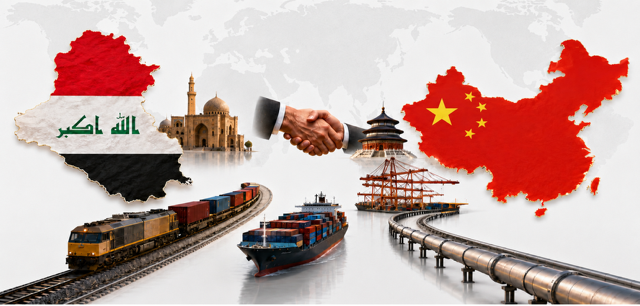
Illustration of Iraq–China economic and energy ties, produced by the Iraq Energy Outlook technical team using OpenAI assisted image generation.
THE PREMISE
The premise of this paper is that China’s energy policy in Iraq cannot be understood solely through oil production or trade statistics. Historically, China’s Middle East regional policy was seen as guided by its need for energy and, therefore, national security priorities.[1] While that re-mains relevant, it also has a much broader strategy that combines commercial investment, infrastructure development, diplomatic engagement, institutional partnerships, and elite networks. These interconnected activities collectively strengthen China’s long-term position in Iraq.
Sino-Iraqi Relationship: A Brief History
Understanding China’s contemporary strategy requires examining how the relationship evolved historically. China’s current position in Iraq did not emerge suddenly after the end of the Ba’athist dictatorship in 2003, but developed through several distinct phases, each expanding the scope of Chinese engagement.
The Sino-Iraqi political relationship began in the late 1950s, when Iraq’s political system transitioned from a monarchy to a republic. However, China did not meaningfully engage Iraq economically until much later. Its first foray was a geopolitically significant arms deal during the Iran-Iraq War in the 1980s, before becoming involved in the energy sector during the sanctions period of the following decade.
China had two motivations regarding the war: sell arms to foreign governments and counter the Soviet Union. At the time, the Kremlin appeared to be turning away from Baghdad and toward Tehran. Thinking pragmatically, then-Chinese leader Deng Xiaoping was ready to discreetly arm Baghdad in order to wrestle Iraq from the Soviet sphere of influence.[2] The China North Industries Corporation (NORINCO), an ordnance production conglomerate and major arms sales agent with close ties to the People’s Liberation Army (PLA), was key to this arrangement. The relationship also brought in hard currency for Beijing.[3] By selling arms to Iraq, China was able to contain the Soviet Union, open a new market, and maintain the balance between two hostile countries, namely Iraq and Iran.[4]
These early military ties were significant not only because they established bilateral relations. They also demonstrated a recurring feature of Chinese engagement: economic, political, and strategic interests tended to reinforce one another rather than operating separately. This integrated approach would become even more apparent in the energy sector over time.
In the mid-1990s, China actively began to enter the Iraqi oil sector. At the time, Baghdad was severely hampered by UN sanctions. Under the Oil-For-Food Programme, the UN allowed Iraq to sell oil worth up to 2 billion USD over the course of 180 days in 1996.[5] In June 1997, NORIN-CO was able to leverage its connections with Saddam Hussein’s regime and sign a 22-year production-sharing contract with Iraq, which also in-volved the China National Petroleum Corporation (CNPC), to develop half of the al-Ahdab field after UN sanctions against Baghdad were lifted.[6] CNPC and NORINCO formed a new company, al-Waha, to develop this field.[7]
This foray coincided with a strategic shift for China, which saw it begin to invest more heavily in foreign economies. Known as the “Going Out Strategy” or “外出策略” in Chinese, it was recommended by the 9th Five-Year Plan conference in 1995. Viewed from this perspective, China’s entry into Iraq’s oil sector was not simply a commercial decision by individual firms; It reflected broader national priorities that used overseas energy investments as instruments for expanding China’s long-term geopolitical and economic presence abroad.
Between the arms deals in the 1980s and the oil deals in the 1990s, Iraq built up a large amount of debt owed to China. After the Ba’athist regime fell, the US government urged the Paris Club of debt-holding countries to agree to a reform that allowed an 80% write-off of Iraqi debt. The Chinese government expressed willing-ness to reassess the debt owed by Baghdad, including all governmental debt.[8] While using the Paris Club terms for targeted rescheduling, Beijing favored restructuring the debt discreetly on a bilateral basis, which gave it the ability to tailor programs to specific situations and take advantage of Iraqi political conditions.
China also worked to develop relations with the post-Ba’athist elite. In 2007, it invited new Iraqi President Jalal Talabani to visit Beijing. Be-fore the trip, Talabani expressed a desire to have 8 billion USD of debt canceled.[9] According to Jon Lee Anderson, Talabani was a known Sinophile and an avowed admirer of Mao’s concept of popular war, which involved waging battles in the mountains against oppressive regimes[10]. This successful push-pull approach that took the motivations of the new powerbrokers in Iraq helped to re-launch the relationship with China. Subsequently, Baghdad invited Chinese firms to bid for oil exploration contracts and revived the al-Ahdab field deal that had been signed under the Ba’athist regime. Iraq continued to urge China to forgive its debts[11] and Beijing ended up erasing the vast majority of it.
Therefore, debt relief served a purpose beyond financial restructuring. It helped rebuild political trust be-tween Baghdad and Beijing, creating conditions that facilitated China’s return to Iraq’s energy sector and opened opportunities for wider economic cooperation. This dynamic has increased in recent years.
In May 2024, Iraq held a combined “fifth-plus” and sixth oil and gas bid licensing round. This event, more than any other, captures the contemporary Sino-Iraqi oil relationship. Throughout the three-day event, international oil companies were invited to bid on 29 projects. Chinese oil companies outbid many of their competitors, including those based in the West. Ultimately, thirteen blocks were awarded and ten went to Chinese firms, which dramatically expanded their footprint in Iraq.[12]
The winners not only included large, state-backed companies like Sino-pec and China National Offshore Oil Corporation (CNOOC) but smaller, private firms like GeoJade and Zhenhua.[13]
While its initial entry into the Iraqi energy sector was based on opportunism and the identification of political vulnerabilities,[14] China’s domestic policy changes embodied in the “Going Out Strategy” and the increasing demand for oil drove deeper engagement over time.
Consolidating the Relationship
From its initial positioning, the relationship between Iraq and China has expanded year after year. China has gone from being a marginal player in the Iraqi oil sector to a leading one in just over a decade. This has created a misapprehension that the overall relationship is primarily driven by energy interests, but this view is limited and only partially correct. Iraq is also a major consumer market for Chinese goods as well. There are two ways to understand the expansion.
One perspective is to view China as a nation undergoing a transition to a capitalist mode of production, a process that began in the late 1970s and has continued since then. To accomplish this, China needs resources, markets, and consumers. One manifestation of this is the Belt and Road Initiative, which brings foreign countries into a close trading relationship with Beijing and gives it the ability to both market goods over-seas and secure valuable resources to bring home.[15] It often accomplishes this through state-owned companies, which makes it difficult to draw a separation among state, military, corporate, and other sectors. In this regard, many scholars consider China a neo-mercantilist country.
The second view is that in order for China to secure access to oil, it has to go beyond oil. China’s activities in Iraq are interconnected and aimed at securing energy, market access, and influence in society. This approach is also an extension of neo-mercantilism, where energy security, the military, diplomacy, and trade are all combined. This applies both to state-owned enterprises and to nominally independent companies, who have limited freedom to operate on their own.
This is not a one-sided dynamic. Oil is a national issue for Iraq. In fact, it is framed this way in the Constitution, with Article 111 stating that “oil and gas are owned by all the people of Iraq in all the regions and governorates.”[16] Its economic importance cannot be understated because it is the main source of income for the state and society. It also plays a major political role through the rentier state, which shapes governance.
Iraq’s particular history and context has contributed to a culture of suspicion of western IOCs, which gives China, with its ideology and anti-colonial history, a massive advantage. This is particularly potent among the new Iraqi Shia elite, which was pressured by Iran to exclude US oil majors.[17] Therefore, it is not surprising that they favored non-western companies, like those from China, from the beginning.
Beyond straightforward oil deals, the Iraqi government has also relied on China for loans to facilitate development funding. The Iraqi government has realized that it cannot build the country on its own, given that 61.7% of its budget is spent on operating expenditures like salaries, pensions, social security, and subsidies.[18] As a result, it has turned to Beijing for loans to build major infrastructure projects. Moreover, it continues to identify and work with friendly elites. Ac-cording to Mazhar Mohammed Salih, an advisor who served across several different Iraqi cabinets, the man responsible for the blossoming of the China-Iraq relationship over the past decade is Adil Abdul-Mahdi, who is, like Talabani, an Iraqi Sinophile. During his tenure as oil minister and then prime minister, he developed a program known as “oil for infrastructure.”[19]
Once China became an accepted energy partner, cooperation naturally expanded into infrastructure financing and development as well. This represented a qualitative shift in the relationship: oil was no longer merely the object of cooperation, but became the mechanism through which broader economic ties were financed.
Iraq’s 2015 decision to sign up to the Belt and Road Initiative exemplifies this exchange. Abdul-Mahdi argued that “together with our Chinese friends, we tried to seize this historic opportunity for development in Iraq. We proposed the idea of using oil for construction because Iraq requires comprehensive reconstruction of infrastructure and other facilities.”[20] This allowed China to cement its relationship with Iraq unlike any other country in the Middle East — and in a manner that provides mutual benefits.
How China Manages Iraq
If energy serves as the entry point into Iraq, the next question is how China sustains and protects these interests over time. The answer lies in a multilayered strategy that combines diplomacy, institutional engagement, commercial presence, and soft power.
China has an embassy in Baghdad and two consulates. The consulate in Erbil opened in 2014,[21] with the goal of ensuring China’s interests through the cultivation of relationships with local elites. The consulate in Basra opened in 2023[22] and its activities are primarily focused on oil and gas. Cultivating elites and focusing on critical economic sectors are not mutually exclusive; in fact, they are compatible and all of China’s diplomatic posts in Iraq fulfil both missions.
China also networks with and trains junior and middle-ranking Iraqi bureaucrats and oil workers through extensive invitation programs, which is an approach that it has used for the last two decades. In doing so, it expands its network and familiarizes Iraqis from many walks of life with China. However, this structured program rarely lets visiting Iraqis see beyond official propaganda. This imbalance has a direct impact on the nature of the relationship.
Another distinctive feature of China’s approach is the integration of commercial actors into broader state objectives. Chinese oil companies, engineering firms, construction contractors, equipment suppliers, financial institutions, and diplomatic missions often operate in parallel, reinforcing one another’s activities even when pursuing different commercial objectives.
For instance, large upstream investments create demand for Chinese engineering services, which are of-ten accompanied by infrastructure construction, telecommunications cooperation, technical training, and expanding commercial trade. This interconnected model allows China to build an economic ecosystem, which operates strategically, rather than as a collection of isolated projects. Consequently, Iraq’s growing dependence on China extends beyond a destination for crude oil ex-ports to one that involves infrastructure, technology, consumer markets, electricity, and industrial development. As a result, China’s long-term strategic leverage has grown.
This broader strategy is reflected in the diversity of Chinese corporate actors operating in Iraq. State-owned enterprises, private firms, engineering companies, and service providers together create an extensive commercial ecosystem.
TABLE 1. CHINESE COMPANIES OPERATING IN IRAQ’S PETROLEUM SECTOR BY SEGMENT (2026)
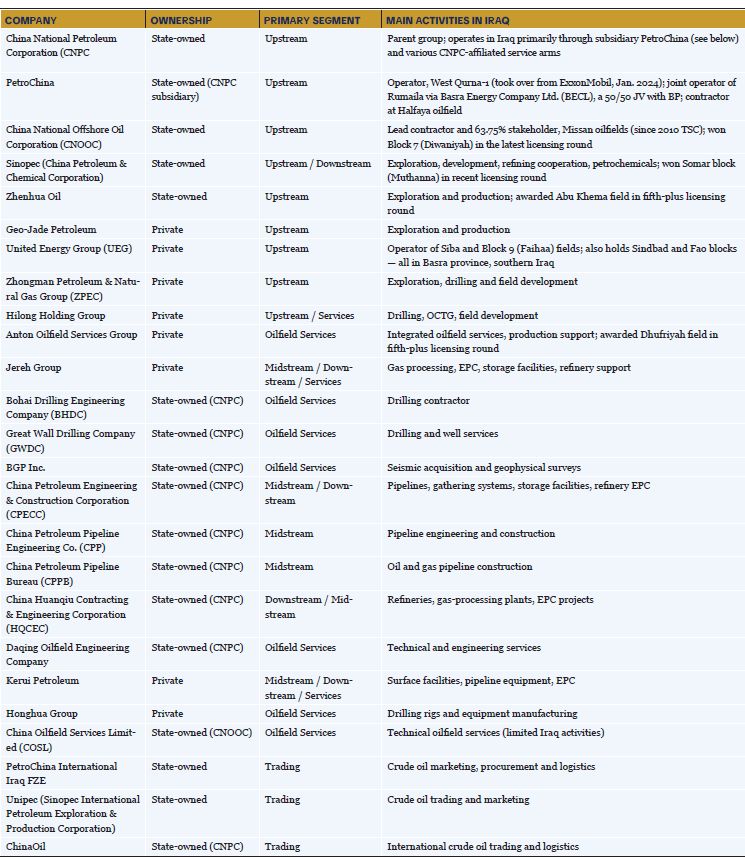
Source: Compiled by research assistants of the Dhia Jafar Center for Energy & Natural Resources, based on Iraqi Ministry of Oil licensing data, company reports, annual reports, and public announcements.
China’s Energy Security Vs. Iraq (Middle East) Insecurity
The expansion of China’s presence raises a broader strategic question: which partner ultimately depends more on the other? Conventional wisdom assumes that China relies heavily on Iraqi oil and, therefore, is somewhat at the mercy of Baghdad. However, developments over the past decade suggest that the relation-ship has become increasingly asymmetric in the opposite direction. China’s energy dependence on the Middle East was regarded as its Achilles heel, especially given the region’s instability and Beijing’s limited ability to project influence over events there[23]. Counterintuitively, the most recent conflict between the United States, Israel, and Iran has shown that this perspective is no longer accurate and energy-producing states have outsized leverage over China.
In fact, Iraq depends more on China, rather than the other way around. In addition to being the largest destination of Iraq’s oil, China is also the main source for affordable goods for Iraqis. Moreover, Chinese companies are also important forces in the contracting, power, and renewable sectors. As a result, there are real questions about whether Iraq has become overly dependent on China and would have to go through structural changes to ensure it is self-reliant.
Some players in Iraq, particularly the ruling elites and Shia political groups, want China to act as a counterbalance to US dominance in the Middle East region, but China does not share this strategic goal. It believes that bad governance, economic mismanagement by regional state actors, unreasonable rivalries between them, and frequent geopolitical interventions are the main causes of volatility and instability in the Middle East.
These developments provide import-ant clues about the future trajectory of Sino-Iraqi relations. If current trends continue, China’s position is likely to become even more deeply embedded within Iraq’s political economy. China is already the biggest international player in Iraq’s up-stream energy sector.[24] It is also better positioned than its competitors in many other crucial sectors, including telecommunications, infrastructure, and the daily goods markets. This provides another layer of opportunities and leverage, in addition to soft power. All together, these factors render China better positioned not only with Iraqi elites but also with the wider society.
Conclusions
The evidence presented throughout this paper suggests that China’s rise in Iraq cannot be explained simply through the statistical increase of oil imports or successful bidding rounds. Rather, Iraq illustrates how China uses energy security as the foundation for building a comprehensive network of economic, political, institutional, and diplomatic relationships that reinforce one another over time.
“Making every province an oil province,” as the newly appointed Minister of Oil Bassim Mohammed Khudair said in a speech, is a sign that Iraq wants to rely more on oil.[25] That strategy makes Iraq more bound to the energy market and its instabilities, which is a risky bid amid geopolitical changes.[26]
Therefore, the diversification of the Iraq-China relation-ship beyond the energy sector is a reflection both of China’s strategic thinking and Iraq’s unique political system in the region, which allows Beijing to penetrate it at multiple levels and influence elites and t he wider society. While energy remains a major part of the relationship, it is hardly the only one that matters these days.
Endnotes & References
1. Jon B. Alterman and John Garver, The Vital Triangle: China, the United States, and the Middle East (Washington, DC: Center for Strategic and In-ternational Studies, 2008). https://www.csis.org/analysis/vital-triangle-0
2. Razoux, Pierre. The Iran-Iraq War. Harvard University Press. 2015. 86.
3. NORINCO Group. Brief of NORINCO Group. (no date) http://en.norin-cogroup.com.cn/col/col432/index.html
4. Razoux, Pierre. The Iran-Iraq War. Harvard University Press. 2015. 87.
5. Office of the Iraq Programme Oil-for-Food. 2023.
6. Downs, Erica Strecke. China’s quest for energy security. Rand. 2026. https://www.rand.org/pubs/monograph_reports/MR1244.html
7. Al-Waha Petroleum. Our history. 2024. https://
www.petroalwaha.com/portal/portlets/informationissues/manage/content/show.php?id=110
8. Acker, Kevin, Deborah Brautigam, and Yufan Huang. Debt Relief with Chinese Characteristics. 2020. Working Paper No. 2020/39. China Africa Research Initiative, School of Advanced International Studies, Johns Hopkins University, http://www.sais-cari.org/publications.
9. Qin Jize. 2007. China to substantially forgive Iraq’s debt. (China Daily) https://www.chinadaily.com.cn/china/2007-06/22/
content_899832.htm
10. Jon Lee Anderson. 2007. Mr. Big. Where is Jalal Talabani taking Iraq? The New Yorker. https://www.newyorker.com/magazine/2007/02/05/mr-big
11. Wikileaks. China-Iraq Oil Contract Highlights Pressure in CNPC. 2008. https://wikileaks.org/plusd/cables/08BEIJING3575_a.html
12. Yesar Al-Maleki. Iraq Bidding: Chinese Firms Dominate. Middle East En-ergy Survey. 2024. https://www.mees.com/2024/5/17/oil-gas/iraq-bid-ding-chinese-firms-dominate/c82ba250-1452-11ef-
a899-9dc8d011780e
13. Iraq Oil Report. Iraq awards 7 new projects in first day of 5-plus/6th licensing round. 2024. https://www.iraqoilreport.com/news/iraq-awards-new-projects-in-first-day-of-5-plus-6th-licensing-round-46518/
14. Downs, Erica Strecker. China’s quest for energy security.. Rand. 2000. https://www.rand.org/pubs/monograph_reports/MR1244.html#:~:-text=China%20thus%20is%20having%20to,the%20motivations%20 behind%20those%20measures
15. Charles E. Ziegler, Rajan. Menon Neomercantilism and Great-Power Energy Competition in Central Asia and the Caspian. Strategic Studies Quarterly, 2014. Vol. 8, No. 2 (SUMMER). https://www.jstor.org/sta-ble/26270802?seq=1
16. Iraqi Constitution. 2005. Article 111. Available on https://
iq.parliament. iq/en/wp-content/uploads/sites/3/2024/04/Constitution-of-the-Repub-lic-of-Iraq.pdf
17. Iraq Oil Report. New details emerge in Iraqi oil deal with China. 2008. https://www.iraqoilreport.com/news/new-details-emerge-in-iraqi-oil-deal-with-china-283/
18. Ahmed Tabaqchali. Iraq’s 2024 budget is not what it appears when it first meets the eye. 2024. Atlantic Council. https://
www.atlanticcouncil.org/wp-content/uploads/2024/11/Iraqs-2024-Budget-Not-What-It-Appears. pdf
19. Mazhar Muhammad Saleh. Discusses the reality of the agreement with China and Iraq’s joining. 2023. WTV. the Belt_and_Road initiative. https://www.youtube.com/watch?v=qeUsSnch-3s WTV. (
2023).د.مظهر محمد صالح: يتحدث عن حقيقة الاتفاق مع الصين والتحاق العراق بمﺒﺎدرة
20. Adil Abdul-Mahdi. China’s modernization is enlightening for Iraq. China Daily. 2022. https://www.chinadaily.com.cn/a/202211/22/WS-637c0741a31049175432b0e3.html
21. Anadolu Agency. China opens consulate in northern Iraq. 2014. https://www.aa.com.tr/en/politics/china-opens-consulate-in-northern-iraq/88226
22. CGNT Official Opining of the Chinese General Consulate Basra. 2023. حافتتا القنصلية العامة لجمهورية الصين الشعبية في البصرة رسميا. https://arabic.cgtn.com/news/2023-10-17/1714231650309967874/index.html
23. Ministry of Foreign Affairs, PRC. Chinese Consul General in Erbil Liu Jun Attends Launch Ceremony and Networking Event of the Great Wall Association. 2025. https://www.fmprc.gov.cn/eng/xw/zwbd/202512/t20251211_11770814.html
24. Oxford Analytica. China will dominate Iraq’s energy sector. 2023. https://www.emerald.com/expert-briefings/article-abstract/doi/10.1108/OXAN-DB281733/479181/China-will-dominate-Iraq-s-energy-sec-torIRAQ-China?redirectedFrom=fulltext
25. Iraqi Ministry of Oil. Oil and Gas are the People’s Resources. 2026. النفط والغاز قوت
الشعب ح2https://www.youtube.com/watch?v=TBYUtP_XDq0
26. Bloomberg News. China's Declining Appetite for Oil Laid Bare by Iran War. 2026. https://www.bloomberg.com/news/articles/2026-05-28/china-s-declining-appetite-for-oil-laid-bare-by-iran-war