


Iraq flared 24.1 billion cubic meters (bcm) of gas in 2025 while importing gas from Iran, which has proved an unreliable supplier over the years. The 2026 war has exposed the fiscal and power sector consequences of that failure. At the same time, lower oil revenues threaten funding for the infrastructure needed to decrease flaring and improve Iraq’s self-reliance.
A Chronic Problem Becomes an Immediate Crisis
Iraq holds one of the world’s largest natural gas resource bases, yet it imports gas and electricity from Iran while burning large volumes of associated gas at its oil fields. This contradiction has persisted through successive governments. The regional conflict that began on February 28, 2026 has turned the issue from a long-standing structural weakness into an immediate threat to public finances and electricity supply.
This is the central issue facing the sector. Iraq does not lack gas. It holds 3.7 trillion cubic meters (131 trillion cubic feet (tcf)) of natural gas, according to its submission to the Gas Exporting Countries Forum in 2024.[1] However, it lacks a system that consistently captures, processes, and delivers the resource to users. Several projects are beginning to address the gap, but they come after years of missed deadlines and will take time to reach full capacity.
Disruption to oil exports through the Strait of Hormuz has reduced the government’s main source of income. Oil normally provides more than 90% of federal revenues, leaving Iraq with few fiscal shock absorbers when export volumes or prices fall. Unlike neighboring Gulf producers, it has neither a diversified economy nor a large sovereign wealth fund that can readily support spending in the face of prolonged interruption. The result is a direct connection between lower oil receipts and the state’s ability to pay salaries, fund fuel purchases, and finance energy infrastructure.
The link between oil revenues and Iraq’s budget matters for the gas sector. Capturing associated gas requires gathering systems, compressors, processing plants, and pipelines. Making productive use of it also requires efficient power plants, transmission lines, and distribution networks. These are multi-year investments whose budgets become vulnerable when oil income falls. Grid rehabilitation is particularly exposed, even though technical and commercial losses mean that a large share of the electricity generated in Iraq never reaches a paying customer due to pervasive non-payment of bills by consumers.
The conflict has also restricted Iranian gas supplies and delayed alternatives, including electricity imports through the Gulf Cooperation Council Interconnection Authority (GCCIA) and plans to receive liquified natural gas (LNG). Lower crude production has compounded the shortage because most Iraqi gas is associated with oil. When oil fields are shut in because crude cannot reach export markets, gas production falls as a result. Iraq has therefore lost export revenue and a potential source of domestic fuel supply at the same time.
Flaring Rises Despite Repeated Reduction Targets
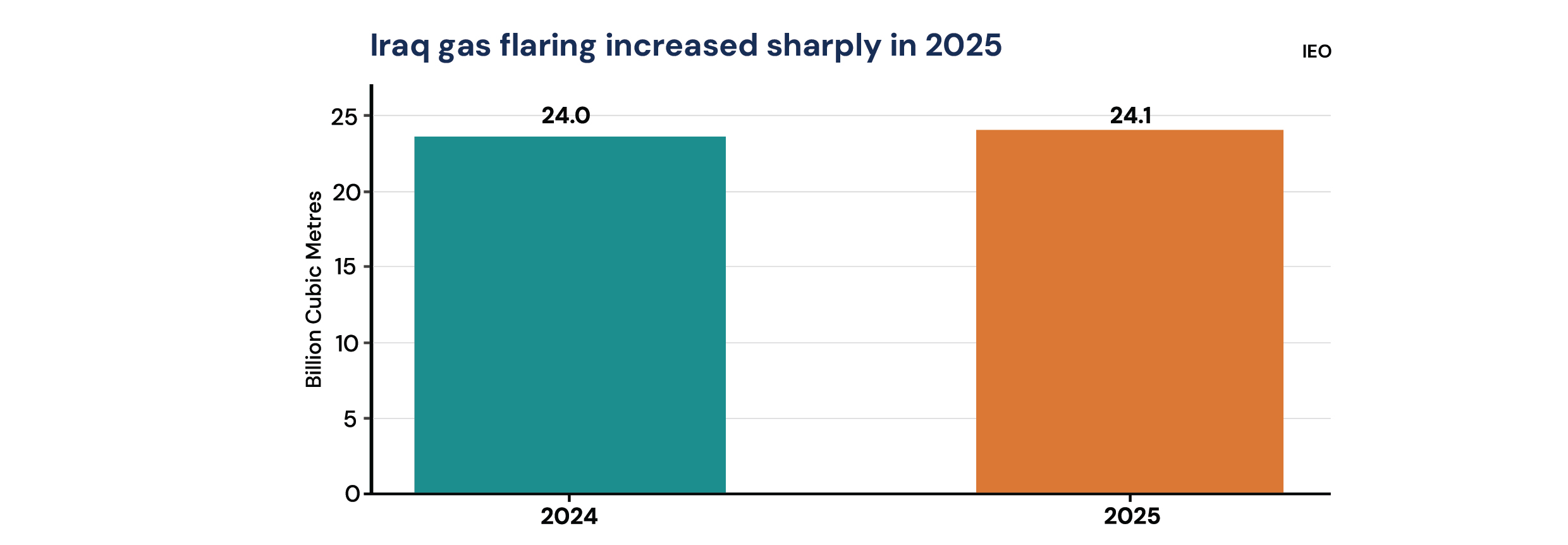
The World Bank’s Global Gas Flaring Tracker, published in June 2026, estimates that Iraq flared 24 bcm of gas in 2025, an increase of less than 1% from 2024, indicating a possible levelling off of volumes.[2] However, the number is slightly misleading as it includes flaring from oilfields, refineries, and industrial users in both federal Iraq and the semi-autonomous Kurdistan Region. The small increase in 2025 also reflects the resumption of oil production in the Kurdistan Region last year. Still, the 2025 total was roughly four times the volume of gas imported by the country. Moreover, it placed Iraq among the world’s largest flaring states, the World Bank noted.[3] The disruption to Iraq’s oil production in 2026 as a result of the US-Iran war will likely show a sharp decline in the volume of gas flared, although it will likely not constitute a trend.
Although negligible, last year’s increase does not support the argument by Iraqi officials that progress has been made to reduce gas flaring in recent years. The World Bank estimates that in 2024, Iraq imported 9 bcm of gas from Iran. Volumes fell to 6 bcm in 2025, far below the contractual volumes because Iran’s internal demand left it with little spare gas to export. Even before the war, Iraq was often unable to pay for Iranian gas and electricity supplies because of US sanctions on financial transactions with Tehran. This meant that supplies were irregular and halted entirely at times. The recent conflict has reduced Iranian flows significantly. The World Bank estimates that imports fell by 70% because of the conflict, which has caused damage to Iranian gas facilities.
Figure 1. Iraq flared 5.8 bcm more gas in 2025 than in 2024.
Source: World Bank Global Gas Flaring Tracker reports for 2025 and 2026
That is the central paradox of Iraq’s energy economy: burning a resource it desperately needs while paying a neighboring state under US sanctions to supply a fraction of what it wastes.
There is also an environmental cost. The Energy Institute’s Statistical Review of World Energy 2026 shows that Iraq’s carbon dioxide emissions from natural gas flaring were the second-highest in the Middle East after Iran. Emissions have come down only marginally since 2015, from 54.6 million tonnes (MT) to 47.6 Mt in 2025.[4] This would indicate that despite efforts to reduce flaring, much more needs to be done to capture associated gas and mitigate the environmental impact of emissions.
Successive governments have repeatedly postponed the date for ending routine flaring. Targets have moved from 2022 to 2025 to 2028 and now to early 2029. Former Prime Minister Mohammed Shia’ al-Sudani’s government announced substantial reductions at selected fields, but national data shows that new oil production and inadequate processing capacity continue to overwhelm the gains.
The volume wasted comes at a huge financial and environmental cost. Gas that could fuel power plants is burned while the government pays for imported energy. Flaring produces carbon dioxide and methane emissions and exposes communities around producing areas, particularly in Basra, to persistent air pollution. It also removes a potential feedstock for fertilizer, petrochemicals, and other industries that could create employment outside the public sector.
A techno-economic assessment published in energy policy in 2026 estimated that gas flaring in Iraq causes potential electricity losses of 8,000–10,000 megawatts (MW) and annual economic losses of $1–2 billion, peaking near $3.3 billion in 2022.[5] The actual numbers vary depending on the quality and location of the gas and on the availability of processing and transport infrastructure, but nevertheless indicate the scale of the opportunity cost: flaring is not simply an environmental problem, but a loss of usable energy and industrial value.
The increase in flaring also exposes a basic tension in Iraq’s oil policy. Baghdad wants to raise crude oil production capacity and output, but each additional barrel from mature southern fields can produce more associated gas. Unless gas-handling capacity grows at least as quickly, higher oil production adds to flaring or forces operators to constrain crude output. Gas investment is therefore required not only for electricity supply, but also to sustain Iraq’s oil ambitions.
The Oil-First Model: Putting the Cart Before the Horse
The origins of the imbalance lie in the first post-2003 licensing rounds. Contracts awarded in 2009 and 2010 concentrated on restoring and expanding crude production. International oil companies were paid remuneration fees linked to the number of barrels produced, while the infrastructure and commercial arrangements needed to gather associated gas were not developed at the same pace. Oil output rose from around 2.5 million barrels per day (bpd) to more than 4 million bpd, but flaring became embedded in the operating model. What this amounted to was putting the cart before the horse with gas as an afterthought to oil. While this was initially understandable, given that Baghdad was rebuilding its battered energy sector, the issue was not addressed by subsequent governments.
Gas was treated as a by-product rather than as the basis of a separate value chain. Responsibility was divided among oil operators, state gas companies, electricity producers, and government ministries. Regulated prices and uncertain payment arrangements weakened incentives to invest, while political disputes and procurement delays slowed projects that had been approved. Later licensing rounds placed more emphasis on non-associated gas, particularly in Anbar, Basra, and Diyala, but they could not quickly correct the absence of gathering and processing capacity in the massive oil fields in the main producing region of southern Iraq.
Iraq’s financial system is characteristic of a rentier economy. Oil exports are virtually the sole revenue generator for the budget. Productive sectors outside the hydrocarbons sector remain limited. A bloated public payroll takes up a disproportionate chunk of state spending, leaving little spare for vital projects. This makes Iraq comparatively more vulnerable to oil price fluctuations than its regional peers, most of which have more diverse economies and stronger fiscal buffers to withstand lower oil prices.
During periods of high oil prices, oil income tends to reduce pressure on the state to collect electricity bills, reform tariffs, or create a commercially viable domestic gas market. When oil revenue is interrupted, the state has lower income and tends to postpone capital spending, reinforcing the infrastructure weaknesses that increase its dependence on hydrocarbons.
Iraq’s Gulf neighbors are also hydrocarbon producers, but most have built larger financial reserves and more diversified domestic economies. They captured associated gas earlier and used it for power, desalination, fertilizer, aluminum, and petrochemicals. Iraq instead imported energy while much of its own gas was flared.
The comparison is not exact. Iraq has a much larger population, a legacy of war and sanctions, and more fragmented institutions. Nevertheless, the absence of fiscal and industrial buffers is now a major source of vulnerability. The Gulf Cooperation Council (GCC) states, led by Saudi Arabia and the UAE, have also invested in renewable energy, which means less gas is required for power generation. In the UAE’s case, nuclear power now accounts for 22% of power generation. When it comes to renewable energy, Iraq’s Ratawi project incorporates solar power, but the country lags behind its neighbors despite its massive solar potential.
The failure to develop petrochemicals represents another lost opportunity. For more than a decade, Shell and the Iraqi government discussed using the proposed complex at Nebras to process domestic feedstock into useable chemicals, before it was ultimately shelved.[6] Iraq lost not only a potential source of non-oil exports, but also the industrial infrastructure, skilled employment, and downstream demand that could have given captured gas a higher value than power generation alone.
Nebras did not fail because of a lack of feedstock, but because of the wider problems that have held back large gas-based industries: uncertain commercial terms, fragmented decision-making, weak infrastructure, and an investment climate where projects can remain under discussion for years. The episode is a warning that capturing gas will not by itself diversify the economy. Iraq must also establish reliable feedstock supply, transparent pricing, and credible long-term contracts for industrial users.
Power Shortages are the Immediate Cost
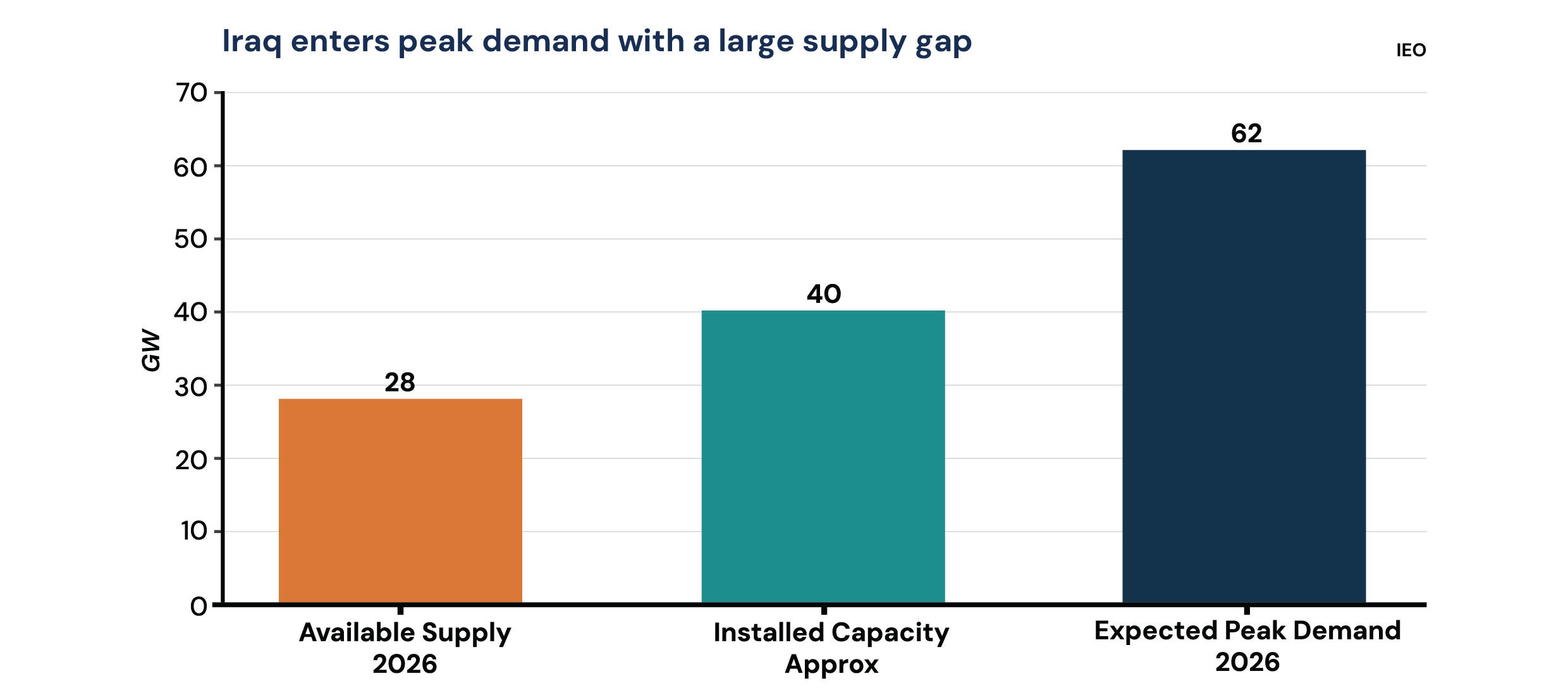
Electricity is where the consequences of the gas shortfall are most visible. Iraq’s power system has expanded, but demand has risen faster and much of the country’s installed capacity is unavailable because of fuel shortages, technical problems, and maintenance. Government projections put peak demand at about 62 GW in 2026, against roughly 40 GW of installed capacity and maximum available supply of around 28 GW. The implied deficit is 34 GW.
Figure 2. Nameplate capacity overstates the electricity available to meet peak demand.
Source: Iraqi government and MEES reporting. Installed capacity includes units unavailable for fuel or technical reasons.
The shortage is aggravated by one of the world’s least efficient grids. Estimates vary by methodology, but the International Monetary Fund (IMF) assessed distribution losses in 2024 at 55%, citing theft and illegal connections that it said led to “significant financial losses.” It noted that the government was taking measures, including deployment of smart meters and improving collection of bills, but these needed to be accelerated to achieve results. “Once collection substantially improves, achieving cost recovery will also require electricity tariff increases, with carefully calibrated subsidies targeted to low-income users. Recent disruptions in electricity imports from Iran further underscore the need for diversified supply and the development of gas projects,” the IMF stated in its Article IV report in 2025.[7]
Yet these are precisely the investments at risk when oil revenues fall. Transmission and distribution projects compete with salaries, pensions, subsidies, and emergency fuel purchases. This year’s export disruption is likely to narrow the capital budget and delay work needed to reduce losses. The fiscal shock perpetuates the power shortage: lower oil income restricts grid investment, inefficient networks waste more electricity, and the government must spend more on fuel and temporary supply.
Households and businesses fill the gap with neighborhood diesel generators. This service is expensive and polluting and firms must bear an extra cost above their normal utility bills. Power shortages therefore reduce industrial competitiveness and make it harder to build the non-oil economy to protect Iraq from future oil shocks.
Extreme heat adds pressure on both sides of the system. Cooling drives the summer consumer demand peak, while high ambient temperatures reduce the efficiency of thermal plants and transmission equipment. Shortfalls in pipeline gas force power stations to burn crude, fuel oil, or gasoil where technically possible. These are less efficient, increase pollution, and divert saleable or imported products into domestic generation.
Before the conflict, Iran supplied around 1.3 billion cubic feet per day (cfd) of gas to Iraqi power plants, alongside electricity exports. These flows were already vulnerable to Iranian seasonal demand, payment disputes, and US sanctions. Their reduction in 2026 exposed the lack of dependable substitutes. Imports can bridge part of the gap, but they cannot replace the need for domestic gas capture and a functioning national network.
Because gas-fired plants account for the majority of installed capacity, shortages of gas have a direct impact on the power sector, which operates below its installed capacity even under normal circumstances. The adoption of combined-cycle power plants has been slow and remains limited.
Projects Begin to Close the Gap
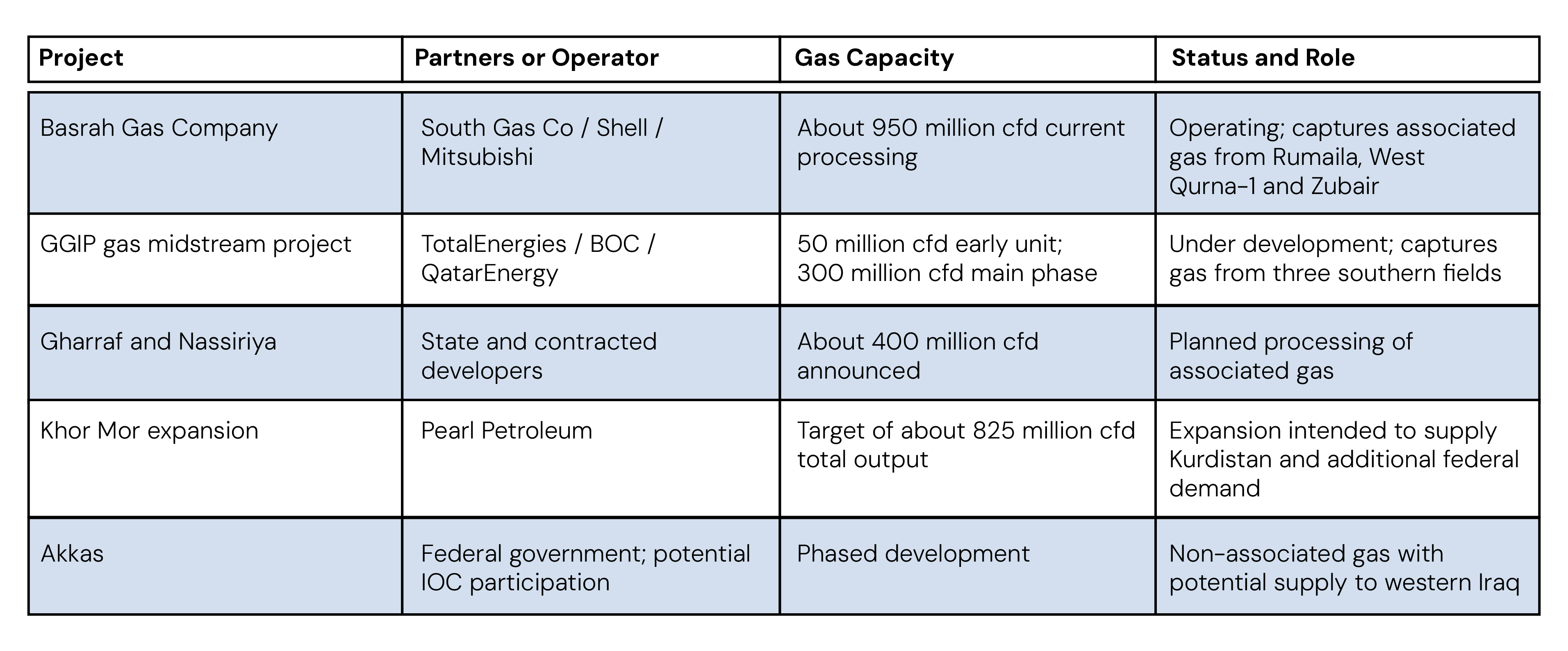
The most important existing gas-capture operation is Basrah Gas Company (BGC), a 25-year joint venture between the state-owned South Gas Company (51%), Shell (44%), and Mitsubishi (5%). BGC gathers and processes associated gas from Rumaila, West Qurna 1, and Zubair. It claims processing capacity has risen from an initial level of 250 million cfd when operations began in 2013 to around 950 million cfd today, producing dry gas for power generation as well as LPG and condensate. However, the BGC is operating below its design capacity because some of the raw gas is diverted to power plants at southern oil fields operated by international oil companies.
BGC demonstrates that large-scale capture is possible when production, processing, and sales are integrated. Its output can fuel around 3.5 GW of generation, according to the company, and helped turn Iraq from an LPG importer into an exporter. But the three fields covered by the venture account for only part of southern production and gathering constraints mean that gas is still flared even within its operating area. Further expansion requires substantial financing and coordination with oil field development.
Basrah Gas Company has increased the volume of gas it captures and processes fourfold during its first decade of operation, from around 250 million cfd to 1 billion cfd. It now accounts for around 80% of Iraq’s processed gas and 95% of its LPG production. The company aims to raise processing volumes to approximately 1.4 billion cfd, while the new Basrah Natural Gas Liquids plant will increase processing capacity by around 40%.
Further growth will require the capture of lower-pressure gas from the second and third stages of oil production. BGC initially concentrated on larger volumes of high-pressure gas, which is easier to recover. It plans to capture around 95% of the gas produced by License Round 1 operators by 2028.
The five-year plan combines a 40% increase in production with a projected 14% reduction in absolute operational emissions and a 45% fall in carbon intensity. Capturing additional gas from upstream operators can avoid around 5 million mt of CO2 equivalent, while operational improvements and planned solar generation could cut a further 1.6 million mt.
TotalEnergies’ estimated $10-12 billion Gas Growth Integrated Project (GGIP) for the first phase is the largest new program under construction. The consortium that controls it includes TotalEnergies with a 45% share, Basrah Oil Company with 30%, and QatarEnergy with 25%. It combines the redevelopment of the Ratawi oil field, gas capture, a 1 GW solar project, and a seawater treatment system. Its first gas unit is designed to process 50 million cfd, followed by a 300 million cfd midstream facility that will recover gas from Ratawi and two other southern fields. TotalEnergies says the processed gas can supply around 1.5 GW of generation.
The combined structure is intended to align higher oil output with gas capture and supporting infrastructure. It is a more coherent model than the early oil-service contracts, but schedules have moved and full commissioning will now be in 2028. The project will reduce flaring at selected fields, rather than solving the national problem on its own.
Iraq has also awarded flare-gas recovery work at Bin Umar and has advanced plans to process gas from Gharraf and Nassiriya, with an announced capacity of around 400 million cfd. Development of the 5.6 tcf Akkas non-associated gas field in Anbar could provide supply that is not tied to crude production, with Baghdad discussing a role for ConocoPhillips at the project. Such fields would make gas availability less vulnerable to oil export interruptions. However, security, infrastructure, and contractual risks remain.
For example, security remains a major obstacle to developing Akkas, although the nature of the threat has changed. Islamic State (ISIS) militants once posed the main risk, but concern has shifted to non-state Shia armed groups. Some of these groups use threats to secure work for affiliated contractors, while others view a US-operated gas project as a target, particularly in the context of the ongoing US - Iran war.
Akkas also presents commercial and logistical difficulties. Its remote location in western Anbar leaves it poorly connected to Iraq’s existing gas infrastructure. As a result, successive development plans have concentrated on supplying power plants within the province. The field is intended to supply the 1.6 GW Anbar CCGT plant, which is under development, but the proposed 250 kilometers long pipeline connecting the two projects has made little visible progress.
Table 1 : Selected Projects and Announced Capacities
Kurdistan Can Provide Part of the Solution
The Kurdistan Region has a separate gas system centered on the Khor Mor field operated by Pearl Petroleum, whose shareholders include Dana Gas and Crescent Petroleum. Gas from Khor Mor supplies power plants in the Region and the expansion program took total output from Khor Mor to around 750 million cfd.[8] While the project has faced repeated security incidents and contractual disputes, it remains one of Iraq’s largest sources of non-associated gas.
Production is also planned from two additional fields in the Sulaymaniyah province, including Chamchamal and Miran fields. Pearl Petroleum is developing the former and is targeting first gas in the second half of 2027. Together, Khor Mor and Chamchamal will have a total capacity of 825 million cfd once the expansions are completed. Miran Energy, a joint venture between US independent HKN and Canada’s Onex, expects production from the Miran field to begin around May that same year. These schedules remain ambitious, but the projects could broaden the Kurdistan Region’s gas supply beyond Khor Mor and provide additional volumes for power generation.
The Kurdish gas sector is already supporting the federal power system. Crescent Petroleum began supplying around 100 million cfd of raw gas from Khor Mor to federal power plants in Kirkuk in August 2026. Independent power producers in the Kurdistan Region, which purchase gas from Crescent, also supply around 1.4 GW of electricity to the national grid, serving Kirkuk, Nineveh, and Diyala, though the end of the summer demand season and conservation measures introduced by Prime Minister Ali al-Zaidi’s government have caused a drop in demand to 1 GW. Further development at Khor Mor, Chamchamal, and Miran could provide additional supply, but pipelines and commercial agreements are required to move gas or electricity consistently across the internal boundary.
The Kurdistan Region has also become federal Iraq’s largest external electricity supplier. Electricity ministry data show that average supplies more than doubled to a record 1.05 GW, or 9.3 TWh, in 2024. Privately operated plants in the Region now provide power to northern federal provinces, increasing Baghdad’s reliance on gas produced at Khor Mor.
That dependence became clear after a November 26, 2025 attack on Khor Mor shut the 750 million cfd field, forcing the Kurdistan Region’s power plants offline and removing as much as 1.2 GW from the federal grid. Khor Mor had been producing around 530 million cfd before the attack and returned to full operations on December 3. The growing electricity trade strengthens the case for developing additional Kurdish gas resources to serve both Regional and federal demand.[9]
Energy constitutes a major part of the wider dispute over constitutional authority and finances between the federal government and the Kurdistan Regional Government (KRG). Further integration will require pipelines and durable commercial arrangements based on better cooperation between Baghdad and Erbil. Investors need clarity about who purchases the gas, how they will be paid, and whether pipelines and power exports can operate during political disputes. Without that framework, technically attractive resources will remain underdeveloped.
Imports Remain Necessary But Cannot Be the Strategy
In July, Iraqi Electricity Minister Ali Saadi Waheeb told the Council of Representatives that electricity output dropped to 22 GW from 27 GW because of fuel shortages and plant outages. He noted that electricity supplies can meet only a third of demand, which he said stood at 60,000 MW. The minister estimated current total distribution losses at 60% because of what he said were “encroachments on transmission lines.”[10]
The ministry aims to raise grid output by 7 GW to 35 GW by 2030, but that would still leave a 25 GW gap even if demand did not grow. The International Renewable Energy Agency (IRENA) lists a more ambitious program of planned generating capacity, although capacity on paper is no guarantee of available power when plants lack fuel and the grid suffers heavy losses.
These figures suggest Iraq could remain dependent on gas and electricity imports even when its current gas projects are completed. Iranian gas and electricity have historically covered a significant share of the power deficit, but those supplies are now constrained by the war, sanctions, and Iran’s own needs. The end of the US sanctions waiver in 2025 already generated uncertainty over payments before the latest conflict. Waheeb explained that the issue was discussed during a visit by Iraqi officials to the US in July, where they sought some flexibility to repay part of Baghdad’s dues to Tehran. It is not clear yet if Washington acceded to the request.
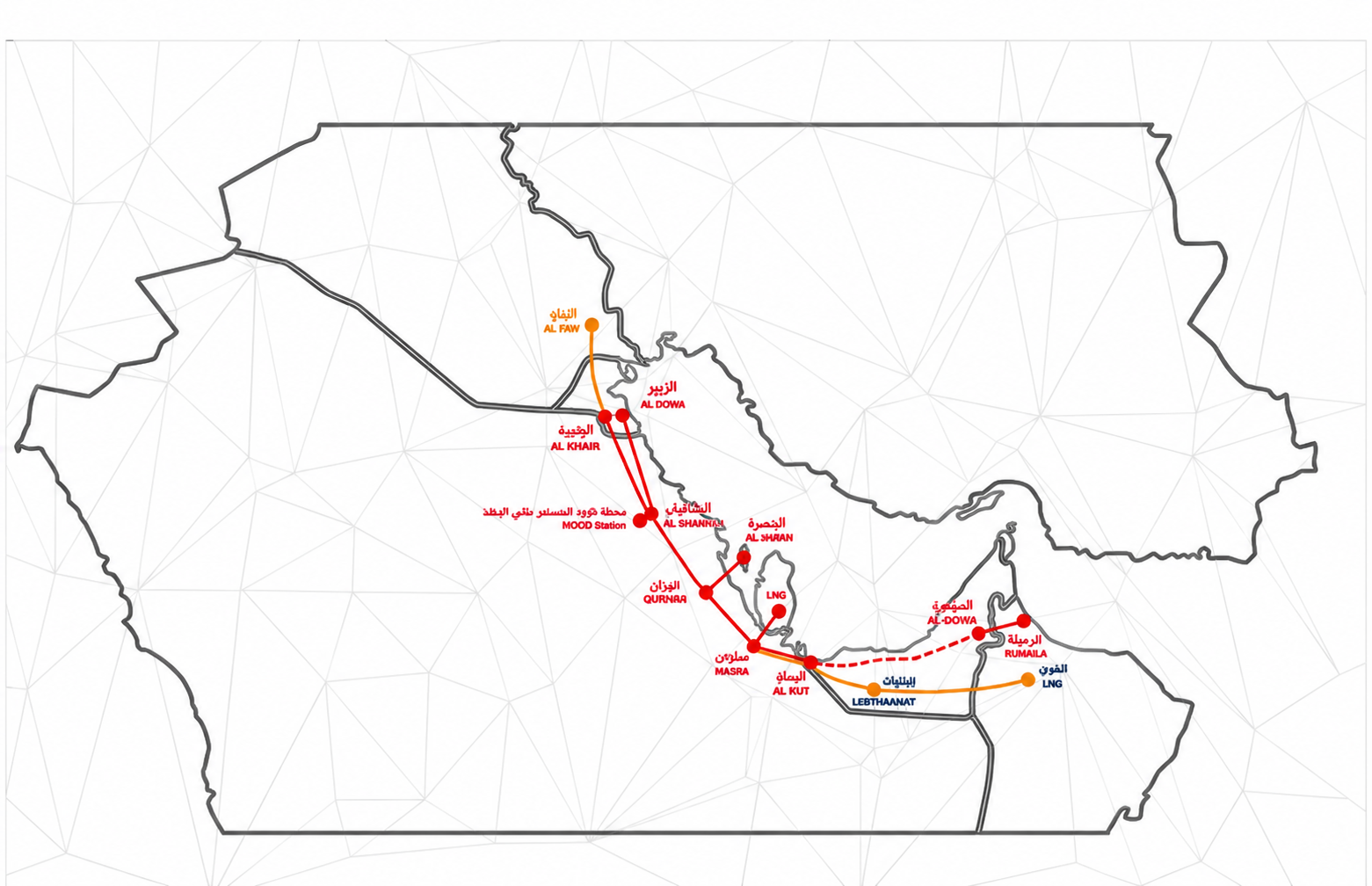
Other options are limited in the near term. The GCCIA link through Kuwait is designed to deliver 500 MW to southern Iraq initially, but commissioning has been delayed and the volume is small relative to the national deficit.[11] Imports from Jordan and Türkiye, proposed floating generation, and additional electricity from the Kurdistan Region can provide incremental relief. LNG could diversify gas supply, but it requires import infrastructure and dependable shipping routes. It would also expose Iraq to international prices and foreign-currency costs.
Figure 3. Proposed GGCIA Interconnection With Iraq
These alternatives should be treated as bridges, not substitutes for reform. An import-dependent power system will continue to expose Iraq to regional risk and external supply interruptions. It will also leave the state paying for gas while domestic volumes are flared.
Renewable energy, particularly solar power, should be part of the solution, but Iraq has lagged behind its regional peers in developing this potential. Iraq’s energy transition plans include adding 12 GW of solar energy and 1 GW of wind power and waste-to-energy projects by 2030. These highly ambitious targets are unlikely to be met by the end of the decade. In September 2025, Iraq commissioned the first phase of the 300-MW Karbala solar power plant, the country’s first grid-connected solar project to date.[12] The only other major project currently under development is the 1 GW solar project by TotalEnergies as part of the GGIP. Iraq has also reached an agreement with the UAE company Masdar to develop another 1 GW of solar, though the project has not yet moved forward.[13]
IRENA notes in its Energy Transition Assessment for Iraq that Baghdad will have to address legislative and financial barriers if it is to attract investors. “Subsidized electricity tariffs further hinder the financial viability of renewable energy projects and discourage energy efficiency measures. Access to financing mechanisms remains limited, despite the Central Bank of Iraq’s initiatives for funding small renewable energy projects. Infrastructure constraints, including outdated grid systems, pose additional challenges to integrating variable renewable energy sources,” it said.[14]
A Narrower Fiscal Margin
The 2026 conflict has made implementation of planned projects more challenging due to the loss of income from oil sales. Restrictions on tanker traffic and reduced crude exports have forced Iraq to use costly shuttle operations and offer large discounts to move some Basra barrels through the Strait of Hormuz. Lower volumes and weaker realized prices cut the cash transferred to the treasury. The precise fiscal loss will depend on how long the current disruption lasts, but a state financed overwhelmingly by oil cannot absorb such a shock without consequences for spending.
Gas and electricity projects face a double exposure. Lower oil production reduces associated gas supply immediately and reduced oil revenue limits the capital available to expand future capture and delivery. Emergency spending on salaries, fuel, and power imports is likely to take priority over grid modernization and industrial development. Contractors may also face slower payments, increasing the cost of financing and the risk of further delays.
This is where Iraq differs from wealthier Gulf exporters. Saudi Arabia, the UAE, Qatar, and Kuwait have also suffered from regional disruption, but they have larger financial cushions, alternative export infrastructure, and more developed non-oil sectors. Iraq’s budget, power system, and wider economy remain tied to the same oil-export chain. A disruption at the Strait of Hormuz therefore passes quickly from the loading terminal to the budget to public services.
What Must Change
Iraq has more gas projects under construction than at any point in recent years and the combination of BGC expansion, GGIP, new processing plants, and supplies from the Kurdistan Region can materially reduce the deficit. The main question is whether projects are completed on schedule and connected to a network capable of delivering and monetizing the gas.
Policy must move beyond announcing flare-reduction targets. Oil-field contracts need enforceable gas-handling obligations and development plans must match each increase in crude capacity with gathering and processing. A clearer domestic gas price and reliable payment mechanism will give producers and industrial users a basis for investment. Federal systems and those in the Kurdistan Region need commercial agreements that survive political disputes.
The commercial framework remains central to attracting further investment. As the World Bank’s Zubin Bamji told Gas Outlook in 2024, Iraq needs “a private investment-enabling competitive, and transparent policy and contractual framework” to attract investment in gas capture.[15]
The power sector requires parallel reform. New gas supplies should be directed to efficient plants, alongside transmission and distribution investment to reduce losses. Metering, billing, and tariff reform are politically difficult, but without them additional generation will continue to leak out of the system financially as well as technically. Protecting grid investment during periods of lower oil revenue will reduce the long-term cost of each fiscal shock.
Finally, captured gas must support more than power generation. Fertilizer, petrochemicals, and other gas-based industries can create export revenue, employment, and domestic demand outside crude oil. The failure of the Nebras project shows that this requires more than resource availability: investors need dependable feedstock, infrastructure, and contractual terms. Replacing imports is the immediate priority, but building an industrial base is the larger economic objective.
Iraq’s present crisis is the cumulative result of oil-first development, delayed gas infrastructure, and an inefficient power system. The country has the resource base and several credible projects with which to change course. However, Iraq will remain exposed to the same cycle until capture, transport, power-sector reform, and industrial use advance together.