


Iraq’s costliest energy failures often occur at the interplay between sectors: a power station built without fuel, associated gas flared instead of captured, or a refinery decision that eases one fuel shortage but worsens another. A national energy system model can test these connections before public money is committed.
The consequences of fragmented energy planning
In 2008, Iraq ordered gas turbines capable of adding as much as 7,000 megawatts (MW) to a nationwide power system that was under severe pressure.[1] Operating them required reliable fuel from a domestic chain of associated gas gathering, processing, and pipelines, but development of that chain lagged behind. In short, Iraq expanded gas-fired capacity before it could supply those plants with enough suitable gas to power them.
The gap soon appeared in operation. The Integrated National Energy Strategy later reported that the new gas turbines largely operated using substitute fuels, with more than half coming from gas oil, crude oil, and heavy fuel oil.[2] An adequate supply of suitable gas would have reduced this dependence and allowed the turbines to run more efficiently.
Ministry of Electricity data for 2024 show that gas-fired plants made up the largest share of operating capacity, yet the electricity system produced on average only about half of its design capacity. Generators continued to burn crude oil, heavy fuel oil, and mixed fuels.[3] Sustained reliance on these substitute liquid fuels can raise maintenance needs and emissions, reduce efficiency, and shorten equipment life. However, the extent of these effects varies with turbine design, fuel quality, treatment, and emissions controls.[4],[5]
Imported natural gas from Iran filled part of the domestic supply gap and gradually became essential to electricity generation. That dependence exposed Iraq’s power supply to interruptions beyond its control. When Iranian gas stopped in December 2025, the grid lost 4,500 MW of generation, equivalent to about 24% of the average grid output of 18,900 MW reported for 2024.[6],[7]
As Iraq’s population and electricity demand grow, each interruption widens the shortage and leaves capacity unable to operate, even though it has already been purchased. This recurring vulnerability shows what happens when generation expands faster than the fuel system needed to support it.
The same planning problem extends across the energy sector. Iraq advances oil fields, gas-capture facilities, refineries, transmission lines, power stations, and regional interconnections through programs that are often prepared separately, when they in fact depend on one another.[8] Higher oil production brings more associated gas that must be captured, processed, and delivered to a customer. Refinery decisions change the supply of diesel and fuel oil used in transport, industry, and electricity generation. A new power station needs both a secure fuel supply and enough network capacity to deliver its output.
A national energy system model can test whether these plans work together and how the complete program can be delivered at least-cost. It would show which investments are needed together, which infrastructure must come first, and how delays affect the rest of the system. These links also cross administrative boundaries, so the proposed national model would cover both the governorates administered by the federal government and the Kurdistan Regional Government (KRG). A two-area structure that retains governorate detail would connect their energy balances, while preserving their different institutions and operating arrangements.
What a national energy system model does
Iraq’s energy system is the chain that turns natural resources and imports into the services on which daily life and the economy depend: electricity in homes, fuel for transport, heat for industry, and energy for water and public services. Oil fields, gas-processing plants, refineries, pipelines, power stations, and networks are all parts of that chain.
The Iraq Energy System Model converts this physical chain into a bottom-up, technology-rich optimization model.[9] It belongs to the same broad family as TIMES, an open-source framework developed through the International Energy Agency’s (IEA) Energy Technology Systems Analysis Programme: demands for energy services must be met, resources and technologies are represented by their costs and physical limits, and the model identifies the least-cost combination of operation and investment across the whole system.[10] It does not predict a single future; it compares internally consistent scenarios under stated assumptions.
Figure 1 traces the model’s simplified 2024 baseline. Of the energy in domestic crude production, 78% goes to exports, 18% to refining, and 4% directly to power generation. Associated gas divides between capture and flaring, at 38% and 62% respectively. Refining and imported oil products provide transport, other fuel uses, and power to consumers and industry. Imported gas, electricity imports, and renewables supplement domestic supply. The final branches show electricity reaching homes, services, and industry, alongside energy lost during conversion and delivery.
Figure 1. Iraq’s Main Energy Pathways
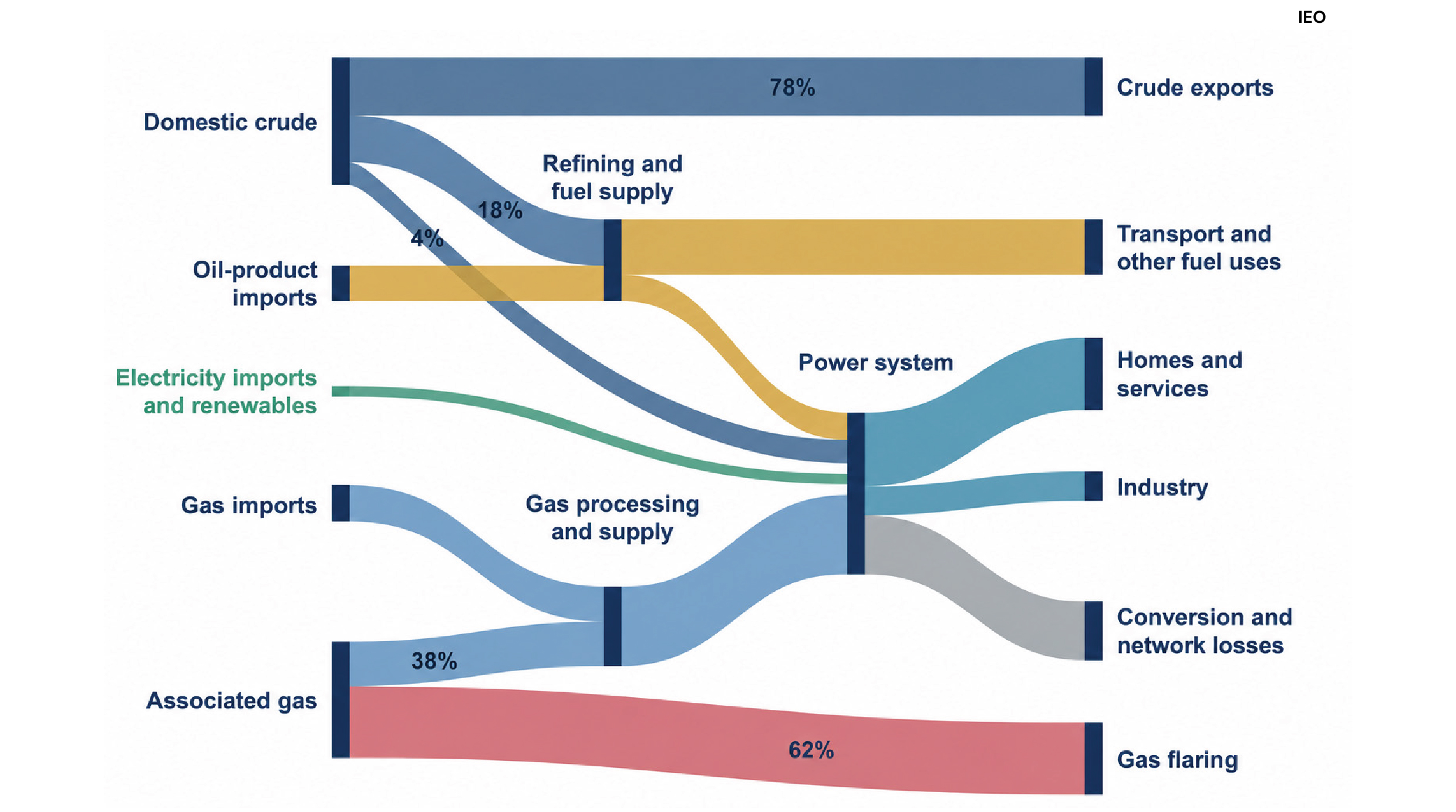
Source: Prepared by the author using the 2024 baseline of the Iraq Energy System Model. Percentages represent rounded energy shares. Flow widths are schematic, crude exports are compressed, and minor flows are omitted. Renewables include solar PV and hydropower.[11]
Within the model, energy moves from domestic resources and imports through conversion plants and networks to final demand. Each resource, process, and technology is defined by its capacity, efficiency, availability, construction time, lifetime, costs, and emissions.[12] Balance equations require every unit of crude oil, gas, refined product, and electricity to be accounted for in each model period. This is what makes the model systemic: changing gas capture, refinery output, or power-generation capacity changes the feasible choices elsewhere.
For each scenario, mathematical optimization decides how existing assets operate, which new assets are built and when, and how fuels and electricity move through the system while demand is met at the lowest total system cost. A scenario can test faster demand growth, delayed gas projects, different refinery configurations, import disruption, demand pathways associated with subsidy reform, or emissions constraints. The result is not a forecast; it is the least-cost response to that scenario’s assumptions and constraints.
Figure 2 summarizes the model architecture. Demand, existing assets, resource availability, costs, policies, and technology options enter as data and scenario assumptions. The optimization links oil and gas, refining and fuels, power generation, and final energy use. It then determines the least-cost system pathway within the stated physical and policy constraints. Its outputs include operation, investment and timing, fuel and electricity balances, trade, total system cost, emissions, and any unmet demand. These results expose cross-sector consequences: a cheap power-sector option may require costly fuel imports, while a refinery may reduce imports of one product but produce more of another than Iraq needs.
Figure 2. Data and Scenario Assumptions Enter One Connected Whole-Energy-System Optimization Model
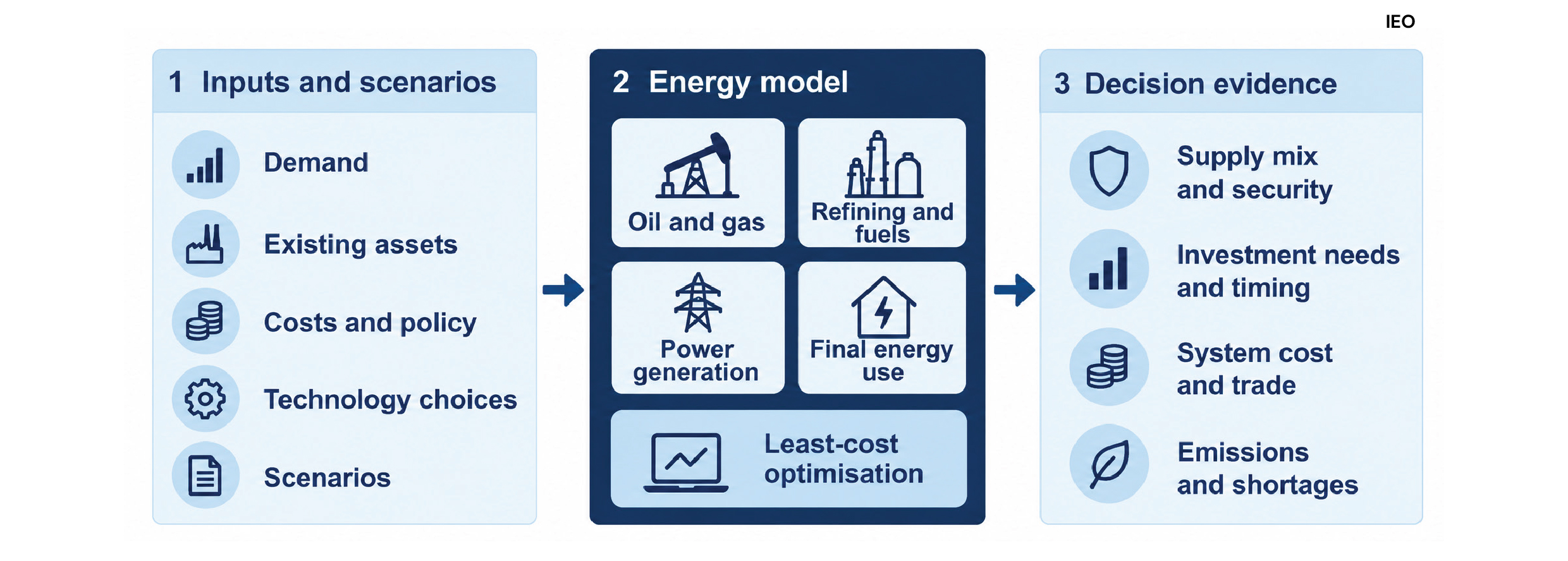
Source: Author’s illustration. These inputs produce results for operation, investment, cost, trade, emissions, and unmet demand.
How the model turns data into decisions
The sequence in Figure 2 begins with a historical baseline: a single account of demand, domestic resources, imports, conversion plants, networks, losses, and emissions in a recent year. Analysts reconcile the datasets so each major energy flow has a documented origin, destination, and unit. Federal and KRG records require particular care, since an exchange may appear in both sets of accounts. The baseline should reproduce the observed system, with any remaining differences explained, before it is used to assess future pathways.
Each existing or possible asset is described by its capacity, efficiency, fuel, cost, availability, construction time, lifetime, and emissions. The model also records the limits on connections between assets. A plant’s generation depends on the fuel that can reach it. Associated gas becomes useful supply only when the facilities to capture, process, and deliver it are available, for example.
Independent power producers, private refineries, and public-private partnership projects belong in this account alongside state assets. The model records their physical and cost characteristics, while supplementary commercial analysis identifies the owner, operator, and buyer, as well as fuel obligations, payment terms, and contract duration. Together, this information shows how each project could operate within a scenario and whether the required contractual arrangements are credible.[13]
Using those records, mathematical optimization searches for the lowest total system cost over the modelled period, in order to meet demand within the physical and contractual limits of each scenario. The calculation considers operation and investment together, including the cost of fuel supplies, networks, and other assets needed to make each project usable.
Institutions responsible for the data should review the records and key assumptions. Results should also be checked against the historical baseline and engineering judgement. Sensitivity cases test how the answers change with demand, prices, delivery dates, or import availability, showing where decisions depend heavily on uncertain inputs.
Regional experience provides useful comparisons. Saudi Arabia’s KAPSARC Energy Model links power, upstream oil and gas, refining, petrochemicals, cement, and water desalination.[14] Meanwhile, Jordan is building national modelling capability in TIMES[15], Kuwait has developed a TIMES model to explore energy and industrial pathways[16], and Türkiye’s ISTEM represents primary supply, final demand, and regional trade.[17] The Iraq Energy System Model belongs to this same broad family of bottom-up optimization models, but is built around Iraq’s particular resources, institutions, delivery constraints, and policy questions.
A national boundary with two area systems
Federal Iraq and the KRG would each have a separate energy balance covering demand, resources, public and private assets, tariffs, and contractual constraints, with governorate detail where it matters. The model connects these balances. Each area’s institutions and operating arrangements determine how its assets and exchanges operate.
Exchanges between the two areas would have a capacity, permitted direction, loss, delivery cost, and availability assumption. The model would represent the physical flows and associated system costs, while supplementary financial analysis could assess purchase prices, payment obligations, and consequences for each participant.
For example, a scenario could compare additional gas deliveries from the Kurdistan Region to federal power plants with an alternative of generating electricity closer to the gas source and transferring the electricity instead. It would show the infrastructure, investment timing, fuel use, losses, and exposure to interruptions for each option, with system costs, reliability, and emissions reported for each area and for Iraq overall.
The same framework could examine existing or prospective energy exchanges with Türkiye, Iran, Kuwait, Saudi Arabia, Jordan, and Syria. Comparing coordinated investment with separate area plans would show where the two areas could benefit and what changes to infrastructure, contracts, or operating responsibilities would be needed.
Figure 3 illustrates this boundary. The map indicates the proposed coverage, while the exchange diagram shows how electricity, gas, oil, and products connect the two area balances. The model would calculate the scale and direction of these exchanges for the infrastructure and contracts specified in each scenario.
Figure 3. Two Area Systems Within One National Model.
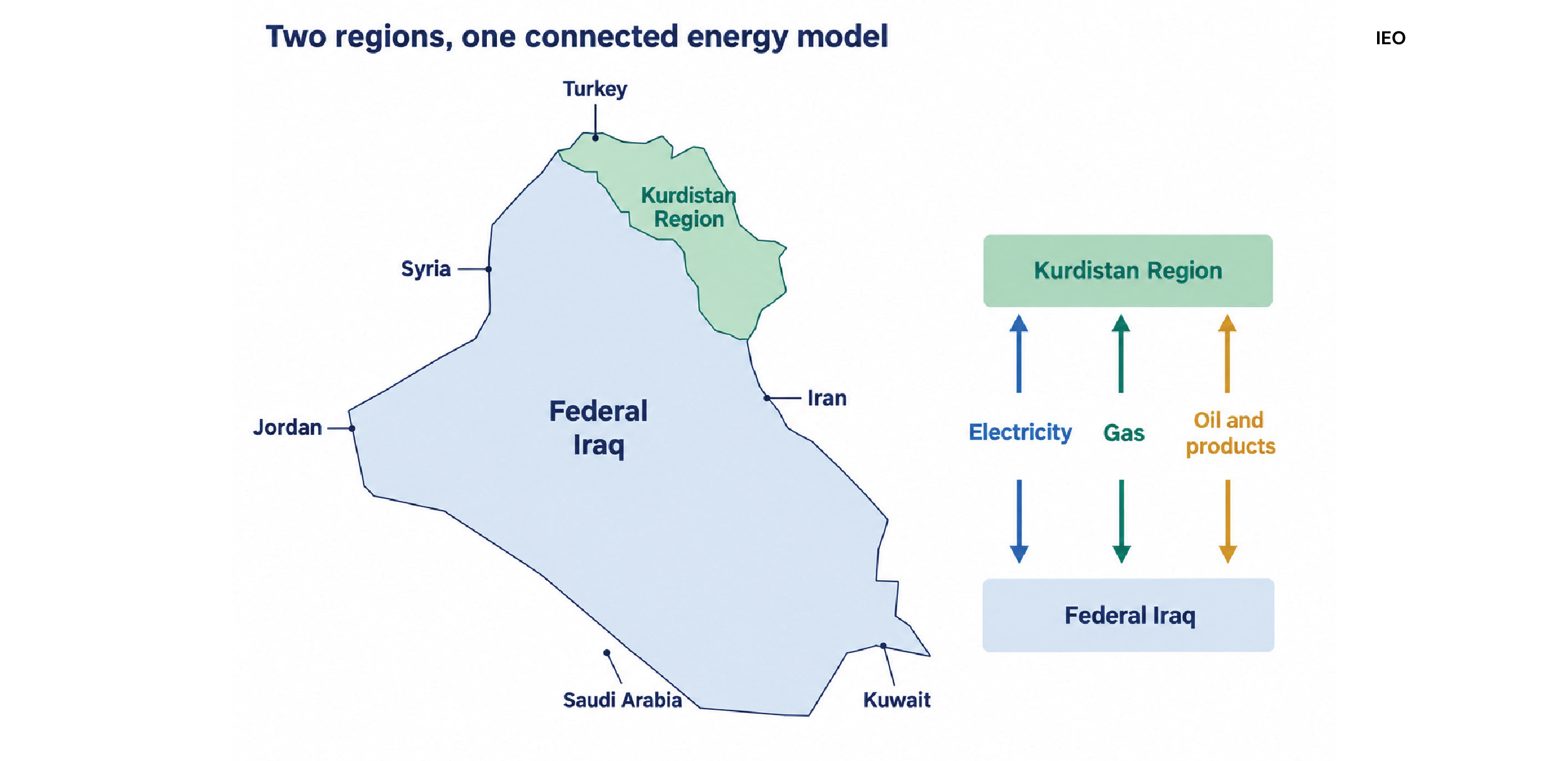
Source: Author’s illustration. Area boundaries and connections are schematic.
The questions a national model can test
A national model is most useful when it is built around a limited set of decisions that matter across government: how Iraq can meet future needs, what each major policy choice requires elsewhere in the system, and how cost, security, trade, and emissions change together?
What is the least-cost way to meet Iraq’s future energy needs? The national model can identify the combination of domestic resources, imports, processing, infrastructure, and technologies that supplies electricity, refined products and other energy needs while respecting fuel availability, existing capacity, construction time, and policy constraints. Least-cost here means the cost of the complete system over time.
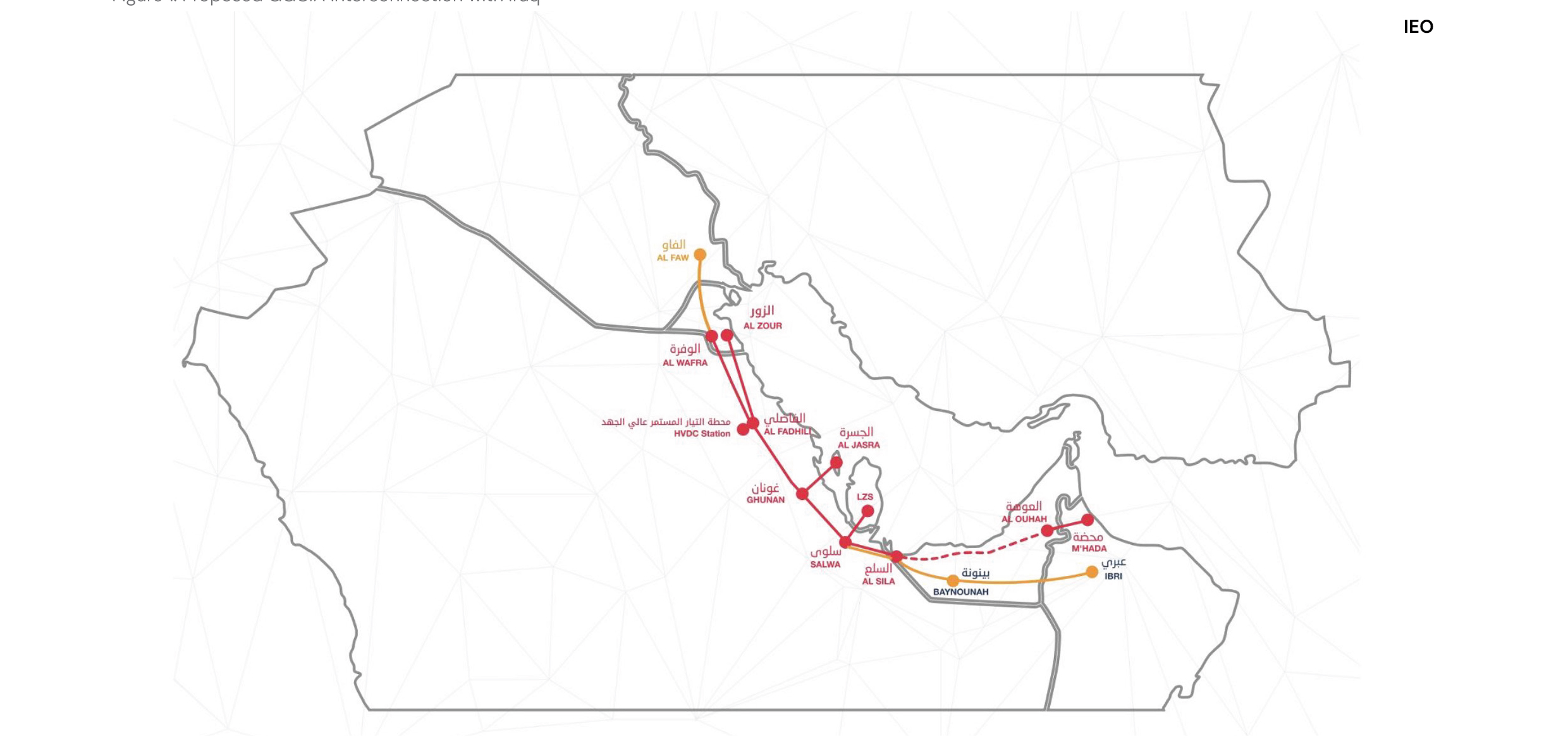
What results if Iraq raises oil production by 2030 and 2040? Higher crude output requires upstream and export infrastructure and produces more associated gas. The model can trace how much gas must be captured, processed, delivered, reinjected, or flared, whether refineries use more crude, and how exports change. The gains depend on which investments are ready first. Additional gas improves electricity supply only if gathering, processing, and power capacity are ready; extra refinery throughput reduces product imports only if it matches demand. Figure 4 illustrates these links for the model to test.
Figure 4. A higher oil-production pathway can affect gas capture, refining, power, trade, investment, and emissions.
Source: Author’s illustration, showing illustrative directional trends rather than specific model results or forecasts.
How can Iraq strengthen energy security at an acceptable cost? Domestic gas, imported gas, electricity trade, and alternative supply options differ in cost, delivery time, and exposure to interruptions. The model can test how the system performs when an import route is interrupted or a domestic project is delayed. The results would trace the effects on generation, fuel use, product trade, investment and shortages, and identify which measures taken in advance would reduce the damage most effectively.
What are the costs and benefits of meeting Paris Agreement commitments while demand grows? The model could compare an emissions-focused scenario with a least-cost reference pathway, both meeting the same energy needs.[18] The comparison would show what changes are needed in flaring, fuels, infrastructure, and technology and quantify the additional investment and system cost. It would also measure changes in emissions, fuel waste, import exposure, and efficiency, helping Iraq to assess climate measures alongside its development and energy-security priorities.
Which pathway remains credible when plans slip or assumptions change? Demand growth, construction schedules, fuel prices, technology costs, and import availability are uncertain. Testing different assumptions shows which decisions remain useful across several future scenarios and which depend on one optimistic assumption. This helps the government distinguish investments that are urgent and durable from those that can wait for better information.
How can subsidy reform reduce waste while protecting essential energy use? The model could compare subsidy-reform scenarios based on different assumptions about government-set prices, metering, payment collection, and protection of essential household energy use. The scenarios would translate these assumptions into alternative demand and loss pathways. Supporting financial and sector data would separate the cost of supplying energy, customer payments, and the government subsidy bill, while distinguishing technical losses, unmetered consumption, unpaid bills, and fuel diversion. This is necessary because each requires a different remedy.[19] The model could then estimate how each reform pathway changes fuel use, infrastructure requirements, system costs, and shortages.
For electricity, the model could compare alternative demand scenarios based on assumed responses to improved metering, more efficient appliances, and tariff reform. Each scenario would specify a different electricity-demand pathway, allowing the model to estimate the resulting changes in fuel use, infrastructure requirements, system costs, and shortages. These assumptions could be revised as better evidence becomes available, helping the government to assess the potential effects of reform.
Together with the other scenarios, these comparisons would give decision-makers a common account of energy supplied, infrastructure required, fuel used, imports and exports, system costs, shortages, and emissions. This evidence could then inform project appraisal and the national investment program.
From evidence to an investable national plan
Before procurement, each proposal should identify the need it will meet, the fuel, network, or supporting assets it requires, and when those will be ready. The model should also compare other ways to provide the same service and test what happens if delivery slips. Those findings should inform appraisal, budgeting, and contracting.
Federal and KRG energy institutions should each validate their own production, demand, assets, and operating assumptions, while a joint technical process reconciles exchanges and common scenarios. Planning and finance institutions would use those results to prepare investment programs and budgets.
The plan for each interconnection should name its asset owner, operator, dispatch authority, and fuel supplier and identify those responsible for payment, maintenance, and renewal. Supplementary analysis should assess payment delays and contract expiry, while model scenarios test the resulting effects on availability, interruptions, and delivery costs. Together, these analyses would show how exchanges can remain reliable over time.
State companies, private operators, regulators, universities, and sector specialists can challenge costs and delivery schedules. The effects of a changed assumption should be calculated for the whole system and reported for each area, as well as for Iraq overall.
Political and fiscal pressures also affect which investments go ahead. Iraq’s dependence on oil revenue makes capital spending vulnerable when prices fall, while recurrent commitments leave limited room to adjust.[20],[21] Annual budgets and political timetables favor projects for which one institution can announce and take credit. Gas gathering, pipelines, rehabilitation, maintenance, and data systems often attract less attention, even when several major projects depend on them. The model can quantify the electricity lost, imports required, and additional system cost when this supporting work is delayed, making those consequences clearer when budgets are prepared.
The same evidence can support private investment. Investors and lenders need to know that an asset has credible demand, that its fuel and network connections will be available, and that it remains useful if prices or delivery dates change. The model can assess whether an asset meets a system need and identify what else must be ready. A bankable project also requires regulation, transparent procurement, reliable payment arrangements, consumer protection, and a sensible allocation of construction, fuel, demand, and political risks through policy and contracts.[22],[23]
Making whole system modelling routine
Projects, prices, and demand will change, so the model needs regular updates. Federal and KRG institutions will need to agree who leads the work and name those responsible for the data. The historical baseline should be documented, with changes to costs, delivery dates, and fuel availability recorded through version control. Ministries and operators can use common scenarios within their existing responsibilities. Assumptions and the reasons for differences between cases should be open to review, so each institution can trace the evidence behind the results.
Before a project enters the national investment program, the model should test the need for the new proposal and its dependencies. Procurement should include scenarios for delays and price changes. A major change in oil production, gas delivery, demand, or regional trade should trigger a new comparison of the investment sequence. Results should show energy supplied, fuel used, imports and exports, shortages, cost, and emissions in terms decision-makers can use, with the technical detail available for scrutiny.
Iraq committed to generation before the fuel chain was ready. It then faced the challenges of relying on substitute fuels, underused capacity, and dependence on imported gas. Modelling those links before procurement could have exposed the missing investments and the cost of delay. Political leaders could then make those choices with their physical and economic consequences laid out before resources are committed. Therefore, using a national energy system model routinely would help Iraq decide which investments belong together, what must come first, and how to respond when plans change.