

Fuel Sector Reform Triggers Political Backlash
Iraqi Parliament questions Oil Minister Basim Mohammed Al-Khudhair over the fuel-products crisis, September 20, 2026. 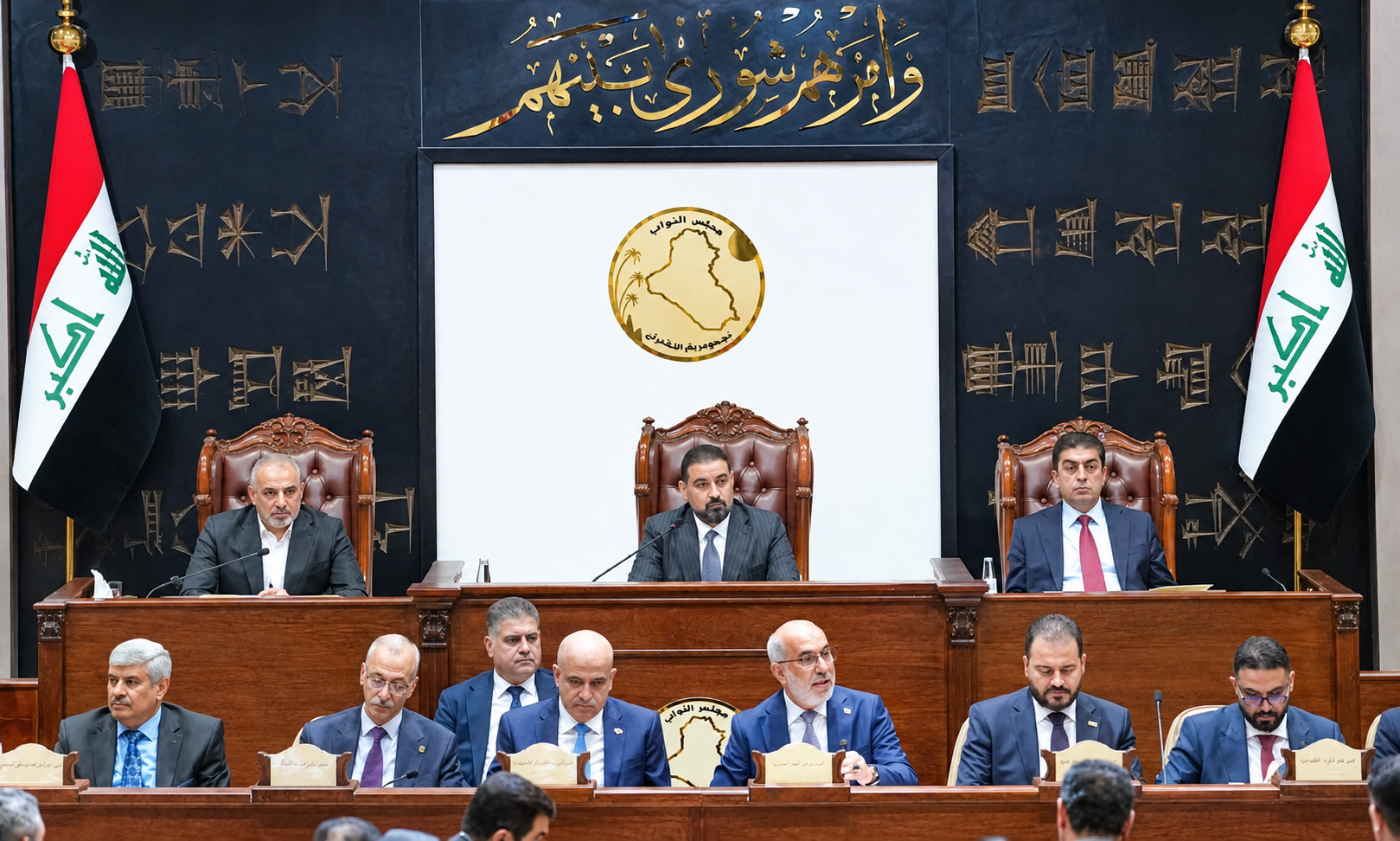
Source: Official Facebook account of the Iraqi Council of Representatives.
What Happened?
On August 18, 2026, Iraq's Council of Ministers approved one of the most significant reform packages for the downstream petroleum sector in decades. The measures aim to improve the financial sustainability of the state-owned refining industry by introducing market-based pricing for crude oil supplied to public refineries, replacing a long-standing arrangement under which crude was sold at a heavily subsidized nominal price. Iraq's explicit fuel subsidies cost around 8 billion USD, or 2.9% of Gross Domestic Product (GDP) in 2025.[1] The reforms are also intended to reduce wasteful spending, improve the transparency of financial flows within the oil sector, and return a larger share of oil revenues directly to the federal treasury. This comes at a time of continued fiscal pressure following the wartime disruption of crude exports, which saw gross oil revenues collapse from 6.81 billion USD per month in February 2026 to around 900 million USD by May.[2]
The reforms generated an immediate backlash. Within days of the Cabinet's decision, thousands of employees at state-owned refineries in Basra, Baghdad, and Dhi Qar protested against the new pricing mechanism. Workers argued that higher feedstock costs would substantially reduce refinery profitability, threaten employee incentives and profit-sharing schemes, and ultimately weaken the financial position of state refining companies.
The controversy soon spread beyond the refining sector. On September 22, members of the Iraqi Parliament formally urged the government to reconsider the package, particularly its provisions on fuel subsidies and crude pricing, reflecting the growing political sensitivity of the issue.
Why It Happened?
The reform is rooted in Iraq's broader fiscal adjustment strategy. For decades, crude oil supplied to state refineries was transferred at symbolic prices that bore little relation to market values. While this practice kept the cost of refined products artificially low, it also obscured the true economic cost of domestic fuel consumption, reduced transparency within the oil sector, and limited the revenues reaching the Ministry of Finance.
However, this status-quo may not be affordable anymore. The export disruption earlier this year left a severe gap: monthly operational spending requirements reached 11.769 trillion IQD (7.85 billion USD at the current exchange rate), while monthly oil revenues recovered to only $1.52 billion by June.[3] Since then, the government has intensified efforts to improve fiscal management without raising taxes or cutting public sector employment. Reforming internal pricing arrangements within the petroleum sector offers one of the few opportunities to strengthen public finances while improving efficiency. At the same time, the government chose to retain subsidies on petroleum products sold to consumers, the main component of the 8 billion USD subsidy bill. This created uncertainty over how state refineries will absorb higher crude costs without undermining their financial viability.
Why It Matters for Iraq?
The debate extends far beyond refinery accounting. It reflects the central challenge facing Iraq's economic reform agenda of balancing fiscal sustainability with political acceptability. Economically, more realistic crude pricing is an important step toward greater transparency, stronger budget revenues, and fewer hidden subsidies that distort resource allocation. In the long run, clearer pricing signals could also encourage more efficient refinery operations and provide a sounder basis for evaluating future investment in the downstream sector.
Politically, however, fuel subsidy reform is one of the most difficult policy decisions in Iraq. The rapid reaction by protesters and the parliamentary opposition showed how reforms affecting state-owned enterprises can quickly become contentious, particularly when employees fear declining incomes or future privatization. Without a clear communication strategy and well-defined mechanisms to protect workers' legitimate entitlements, even economically justified reforms risk losing public support.
What to Watch Next?
Attention will now turn to whether the government modifies the package before full implementation. A key question is whether, under the final commercial model governing relations between upstream producers, state refineries, and the Oil Products Distribution Company, refineries will continue buying crude at market-based prices or move to a processing-fee model. The final arrangements will determine the effectiveness of the whole reform package.
The government's willingness to engage with refinery management, employees, and Parliament will largely determine whether the reform becomes a sustainable restructuring of Iraq's downstream sector or another example of economic reform that stalls in the face of political resistance. The outcome will be an important indicator of Baghdad's broader capacity to implement structural fiscal reforms while maintaining social and political stability.
Iraq Continues South-to-North Efforts to Expand Oil Exports Through the ITP
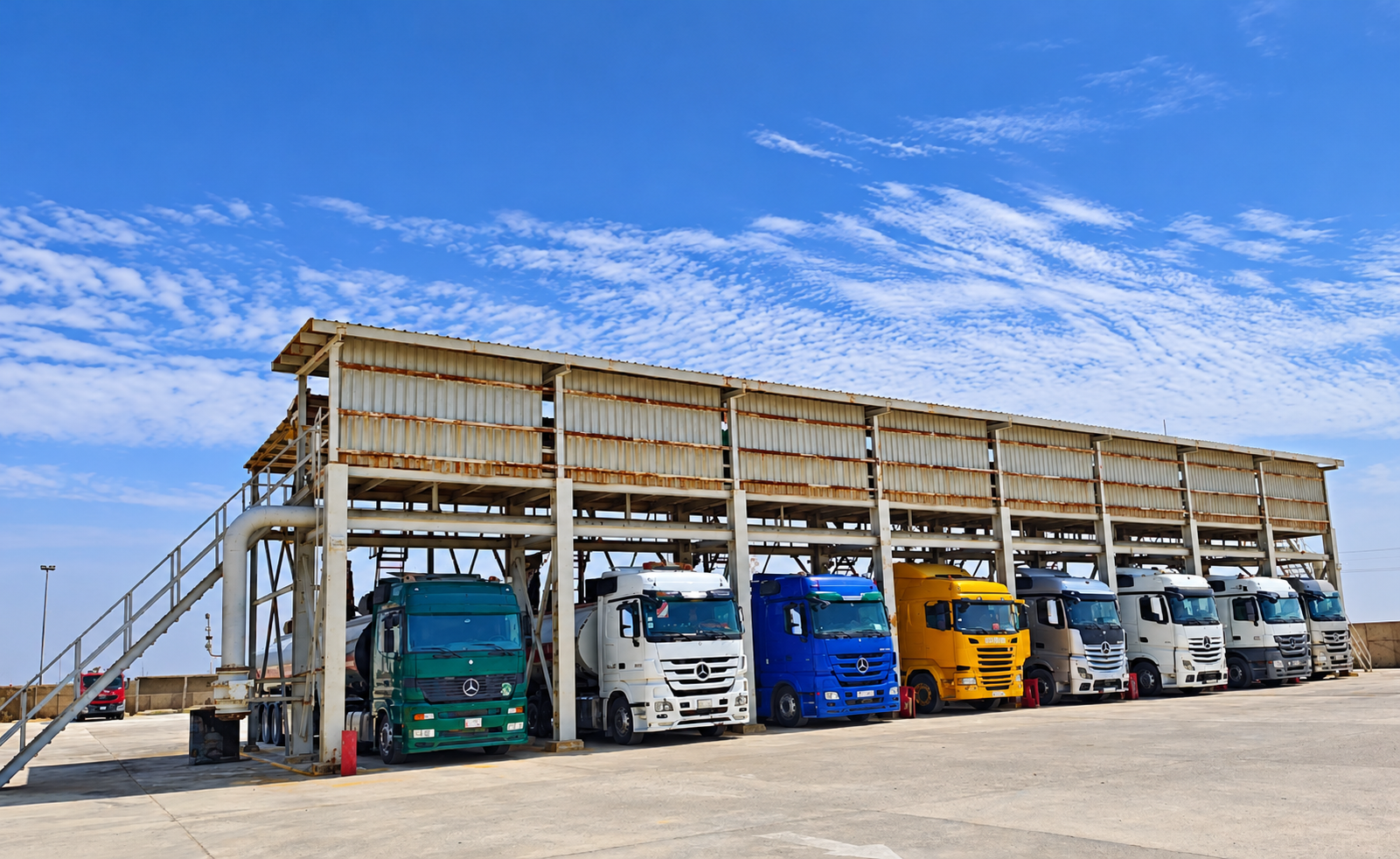
A newly built tanker-truck loading platform at the Ahdab oilfield, where crude oil is loaded for transport to storage facilities in Kirkuk for export through the northern pipeline system.
Source: Iraq’s Ministry of Oil.
What happened?
Iraq is intensifying its efforts to increase crude shipments through the northern export system as continued disruption in the Strait of Hormuz constrains its dominant southern route. The most immediate measure was to truck crude from Basra to northern infrastructure connected to the Iraq–Türkiye Pipeline (ITP). Under an agreement with SOMO, ONEX started trucking crude oil to IT1 crude oil gathering and pumping station in Kirkuk and KAR Group began moving crude from Basra’s Zubair-1 depot toward Khurmala in September, with additional loading from Tuba and other locations. The arrangement targets around 5 million barrels per month, equivalent to roughly 165,000 barrels per day (bpd). Plans indicate that volumes could reach around 275,000 bpd.[4]
The trucking operation follows a more significant institutional development. On August 1, SOMO, the North Oil Company, and Türkiye’s BOTAŞ signed a one-year agreement allowing Iraqi crude to continue moving through the ITP to Ceyhan after the previous bilateral treaty expired on July 27. The agreement establishes a minimum export quantity of 750,000 bpd, while Iraq and Türkiye negotiate a broader long-term framework.[5]
Why it happened?
The regional war exposed a structural weakness that Iraq had been able to tolerate during normal market conditions. Around 93% of Iraqi crude exports normally depend on the Gulf route, leaving government revenues highly exposed to disruption in the Strait of Hormuz.[6] When southern exports collapsed during the crisis, the northern corridor became Iraq’s most credible existing alternative.
The problem is that export infrastructure and production are geographically mismatched. Most of Iraq’s spare production capacity is concentrated in Basra and the south, whereas the ITP begins in northern Iraq. Production from Kirkuk and the Kurdistan Region alone is insufficient to utilize the available export capacity, while part of northern production must also supply domestic refineries and power generation.[7] Iraq therefore has export capacity in the north and crude in the south, but lacks sufficient pipeline infrastructure to connect the two.
Why it matters for Iraq?
What makes the trucking operation economically significant, even if its volumes remain modest compared with Iraq’s overall exports, is its total bypass of the Hormuz crisis and ability to reach international markets through Ceyhan on the Mediterranean. If properly conducted, this operation could help lift total northern exports, including crude from fields in the Kurdistan Region and Kirkuk, to as much as 500,000 bpd. It creates a temporary physical link between southern production and the Mediterranean and allows Iraq to monetize crude that might otherwise remain shut in when Gulf exports are constrained.
But trucking is an expensive bridge and not a long-term solution. Moving 150,000–175,000 bpd over hundreds of kilometers requires thousands of tanker movements and remains far below the 750,000 bpd envisaged under the new Türkiye agreement. The commercial terms also matter: the ITP tariff is reportedly around $1.62 per barrel. There are differing accounts over whether Iraq could face charges linked to the 750,000-bpd minimum, even when actual throughput is lower.[8]
The crisis therefore strengthens the economic case for permanent north–south connectivity. The Oil Ministry’s planned Basra–Haditha pipeline is designed to move southern crude toward central and northern Iraq and ultimately connect with the ITP, allowing Basra, Maysan, and Dhi Qar production to access Ceyhan. The government has also authorized feasibility work on a broader Basra–Haditha–Kirkuk–Ceyhan corridor.[9]
What to Watch Next?
The immediate question is whether trucking can be scaled sufficiently to push northern exports closer to the new contractual target. More importantly, progress on Basra–Haditha and its connection to the northern system will determine whether Ceyhan becomes a genuine national alternative export corridor or remains a limited emergency outlet. The Hormuz crisis has made the economic rationale clearer: export diversification is no longer simply an oil-sector infrastructure issue; it has become part of Iraq’s fiscal and energy security.
Fuel Products’ Crisis Continues Across Iraq
Tanker trucks transport refined petroleum products from a state-owned refinery to fuel stations.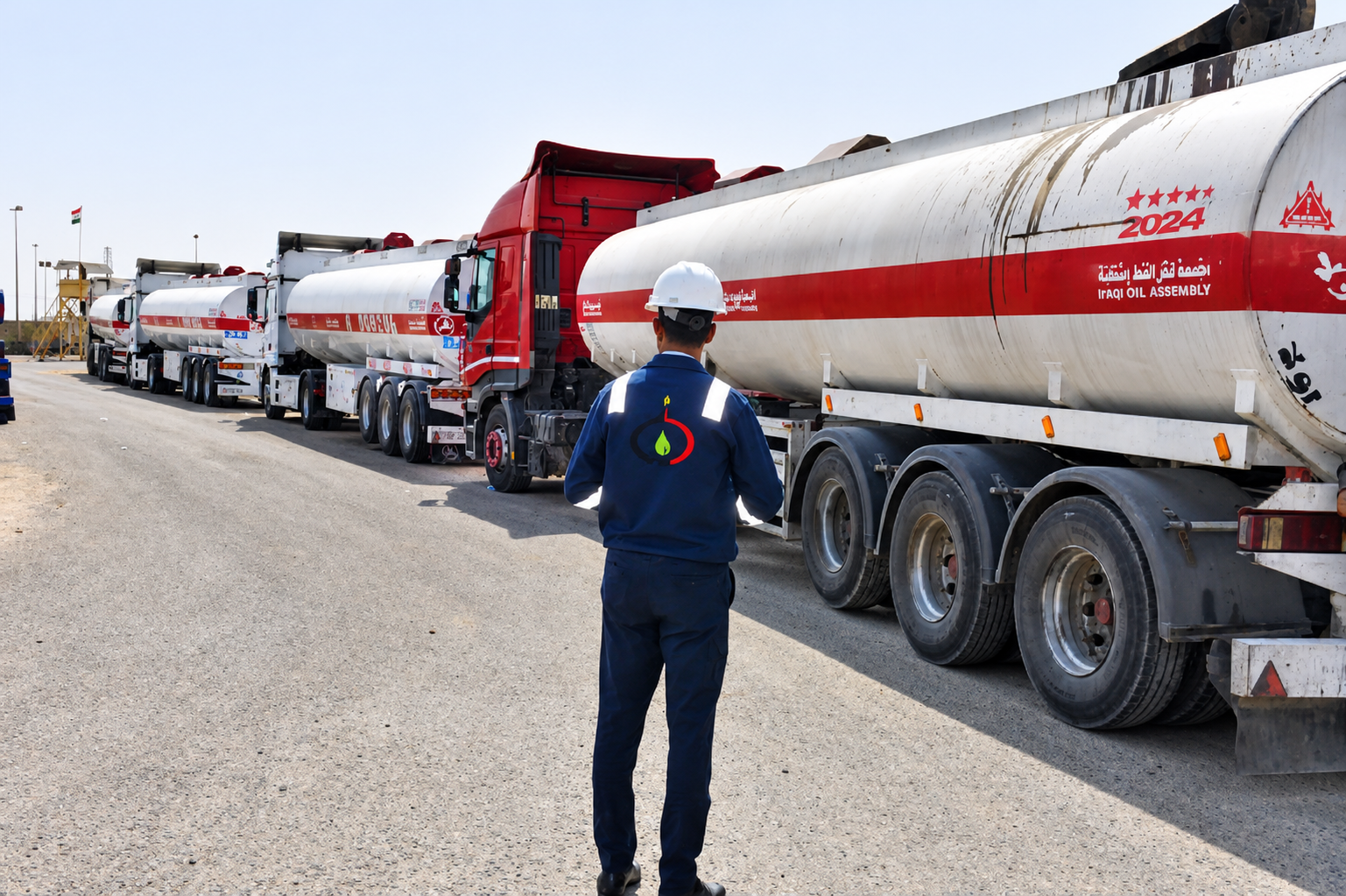
Source: Iraq’s Ministry of Oil.
What happened?
The fuel shortages triggered by the Strait of Hormuz crisis and the regional war involving Iran, Israel, and the United States continue to disrupt Iraq’s domestic petroleum-products’ market. Initially concentrated in the Kurdistan Region, the shortages subsequently spread to federal Iraq, including the oil-producing provinces of Basra and Kirkuk.[10] By September, long queues formed outside filling stations in Baghdad, Kirkuk, and several southern provinces, while some stations in Basra temporarily closed after running out of gasoline.[11] The crisis has exposed a contradiction in Iraq’s energy economy: one of the world’s largest crude oil producers is struggling to supply its domestic market with essential petroleum products.[12]
The Kurdistan Region experienced particularly severe price increases during July. Commercial regular grade gasoline prices exceeded 1,300 IQD per liter in some areas, compared with approximately 800 IQD before the crisis, while shortages affected gasoline, diesel, and cooking gas supplies.[13] Regional gasoline consumption is estimated at around 6 million liters per day.[14] In August, the Kurdistan Regional Government (KRG) expanded its subsidized gasoline distribution to 3.5 million liters per day at 750 IQD per liter, covering the difference between the subsidized price and market cost.[15]
Why It Happened?
The immediate causes were disruptions to refinery operations, reduced imports, and difficulties transporting petroleum products across the country. During the regional conflict, refinery shutdowns and operational constraints reduced domestic fuel production, while uncertainty over supplies encouraged precautionary purchasing.[16] Federal Iraq normally consumes approximately 33 million liters of gasoline daily, according to the Oil Products Distribution Company.[17] Maintaining that supply became increasingly difficult as technical problems, distribution bottlenecks, and delayed imports affected the market.[18],[19]
In the Kurdistan Region, the crisis was compounded by longstanding disagreements with Baghdad over crude oil allocations and revenue sharing. KRG officials argue that the approximately 50,000 barrels of crude allocated per day for regional consumption are insufficient to meet domestic petroleum-product demand.[20] More fundamentally, Iraq’s refining system remains constrained by inadequate storage, limited processing flexibility, and inefficient distribution arrangements. These weaknesses have prevented the country from translating its substantial crude production capacity into reliable domestic fuel supplies.
Why it matters for Iraq?
The economic consequences extend well beyond motorists waiting at filling stations. Petroleum products are essential inputs for transportation, agriculture, electricity generation, and industrial production. Higher fuel prices increase operating costs throughout the economy, potentially raising the prices of food, transportation, and other essential goods and services. Even where official subsidized prices remain unchanged, shortages impose additional costs through lost working hours, longer journeys to obtain fuel, and reduced business activity.
The crisis also comes after several years of pressure on household purchasing power. Iraq’s annual consumer-price inflation averaged 4.4% in 2023, 2.6% in 2024 and 0.3% in 2025, according to International Monetary Fund (IMF) data.[21] Although inflation has moderated, this does not mean that prices have returned to their earlier levels. Renewed fuel shortages could add another round of cost pressures, particularly for households and small businesses with limited capacity to absorb higher energy expenses.
The shortages have also complicated the government’s efforts to reform petroleum-product pricing. Under the new economic model introduced in 2026, Baghdad sought to reduce inefficient subsidies and improve the commercial arrangements governing refining and distribution. However, the reforms encountered opposition from refinery workers, industrial consumers, and parliamentarians. In September, Parliament called for a review of Cabinet Resolution No. 429, citing its potential effects on production costs, transportation, and household welfare.
The underlying policy challenge is that price reform cannot substitute for reliable supply. Reducing subsidies may improve resource allocation and fiscal efficiency, but implementing such measures during a supply crisis risks increasing costs without addressing the structural causes of shortages. Iraq needs both a more efficient pricing system and sufficient refining, storage, and distribution capacity to ensure that petroleum products reach consumers.
What to watch next?
The immediate priority is whether federal and regional authorities can restore stable supplies before winter increases demand for kerosene and other heating fuels. Equally important is whether Baghdad and Erbil can reach more predictable arrangements for crude allocations and petroleum-product distribution.
Over the longer term, the government’s ability to implement its new economic model will depend on improving refinery efficiency, expanding strategic storage, and establishing a more transparent subsidy system. Without these structural improvements, Iraq risks continuing to experience domestic fuel shortages even when sufficient crude oil is available within the country.
Iraq Eyes Higher Oil Exports to Cope with its Fiscal Strains
A drone view shows the Malta-flagged tanker Agios Fanourios I, an oil tanker that sailed through the Strait of Hormuz, arriving in Iraq’s territorial waters off Basra, Iraq, April 17, 2026.
Source: REUTERS/Mohammed Aty.
What Happened?
Iraq’s draft 2027 federal budget rests on an ambitious recovery in oil exports at a time when the country continues to face severe logistical constraints. The draft assumes exports of around 4 million barrels per day (bpd), including Kurdistan Region crude, at an average price of 58 USD per barrel. With nearly 1 million bpd allocated to domestic fuel consumption, this implies national output of around 5 million bpd. Total expenditures are projected at around 217 trillion IQD (144.6 billion USD at the current exchange rate), with a forecasted deficit exceeding 40 trillion IQD.[22]
The export assumption is particularly ambitious under current conditions. Iraq’s southern exports recovered from around 1.35 million bpd in July to 2.34 million bpd in August, but remained well below the more than 3.3 million bpd exported before the war. In September, southern exports rose further to around 2.6 million bpd and total national exports exceeded 2.96 million bpd, helped by substantial discounts and greater involvement from international oil traders.[23] The recovery nevertheless leaves a considerable gap between current exports and the 4 million bpd assumed in the 2027 budget.
Iraq’s ambitions to boost oil production also have implications for its relationship with OPEC+. Iraq has gradually been allowed higher output under the group’s 2026 production adjustments, while OPEC+ continues to emphasize compliance with agreed production levels.[24] With the UAE leaving OPEC in May 2026, in part because of years of disagreement over production constraints, questions of national production capacity and market share have become increasingly important for the remaining producers.[25]
Why It Happened?
The underlying driver of this planned production increase is fiscal. With expenditure planned at around 217 trillion IQD and oil still the dominant source of government revenue, Baghdad has a strong incentive to restore export volumes as quickly as possible. The incentive is not new. The IMF already warned before the current conflict that Iraq’s fiscal position was highly vulnerable to oil-market shocks and that large expenditure commitments were increasingly difficult to reconcile with available financing.[26]
The war has made that dependence more costly. Iraq has had to offer unusually large discounts to attract buyers and offset shipping risks. SOMO offered discounts of $25–30 per barrel in some August sales, while September transactions included discounts of $15–20.8 per barrel depending on destination.[27] Higher volumes therefore do not automatically translate into proportionately higher fiscal revenues.
Why It Matters for Iraq?
Iraq’s challenge is no longer simply how much oil it can produce. It is increasingly about how much it can export, at what cost, and at what realized prices. The Strait of Hormuz disruption has demonstrated that production-capacity does not matter when export infrastructure and market access become the binding constraints. Iraq’s heavy dependence on oil makes export assumptions central to fiscal planning.
At the projected export volume, every 1 USD increase or decrease in oil prices will raise or lower annual state revenues by 2.16 trillion IQD (1.44 billion USD). At the assumed price, every 100,000-bpd increase or decrease in exports will raise or lower annual state revenues by 3.13 trillion IQD (2.1 billion USD). Meeting the budget projections will also require raising Iraq’s OPEC+ production quota from 4.431 million bpd to 5 million bpd. In a postwar market, negotiations over this increase could strain relations with OPEC+ and influence oil prices amid a delicate supply-demand balance.
What to watch next?
The immediate test is whether Iraq can move exports toward the 4 million bpd budget assumption. That will depend less on upstream production potential than on the security of the Strait of Hormuz, the recovery of Gulf shipping, and Iraq’s ability to expand alternative export routes.
OPEC+ will be another constraint. The group continues to require members, including Iraq, to comply with agreed production levels and compensate for previous overproduction. Securing substantially more production room could therefore require difficult negotiations over market share.
Ultimately, Iraq’s 2027 fiscal strategy places considerable weight on an oil-export recovery. Without restored market access and sufficient export capacity, higher production targets alone will do little to close the government’s financing gap.